
Particles and word order still feel uncertain
Begin with N5 relationships inside complete sentences instead of memorising one-word translations.
Understand what a grammar pattern means, how it differs from a similar form and why it fits a real sentence — then retrieve it without copying the example.

A grammar explanation can feel perfectly clear while you are reading it and disappear when you need to build a sentence. Recognition creates familiarity, but active use requires you to select a form, conjugate it and place it correctly without the answer visible.
The Japanese grammar system connects explanations to examples, contrasts, focused drills and sentence production. The same pattern returns later through review, reading and listening so it becomes part of the language rather than a note you once understood.
This path fits learners who recognise grammar explanations but still hesitate when the context changes or two similar forms appear together.
Begin with N5 relationships inside complete sentences instead of memorising one-word translations.
N4 practice links endings to intention, sequence, reason and politeness.
Matched examples expose differences in register, stance, certainty and sentence structure.
I study Japanese every day.
Patterns appear when a course mission needs them. This keeps structure, meaning and use together from the first explanation.
How Japanese grammar moves from explanation to production.
Start with the job a pattern performs before learning exceptions or translation shortcuts.
Compare structures that look interchangeable but differ in nuance, register or what may follow them.
Practise the tense, polarity and politeness the message requires instead of one form in isolation.
Move from guided choices to sentence production where the meaning comes first.
Each pattern begins inside a natural sentence or dialogue with reading and meaning available.
A nearby form or plausible mistake shows where the pattern works and where it does not.
Conjugation Dojo isolates form changes until the mechanics stop blocking the message.
Reading, listening and production bring the grammar back under different conditions.
Patterns appear when a course mission needs them. This keeps structure, meaning and use together from the first explanation.
Particles, sentence order, questions, tense, negatives and adjectives
Meaning contrasts and short sentence building
Build a correct basic message when one detail changes
Reasons, experience, intention, obligation and giving or receiving
Conjugation networks and connected exchanges
Explain relationships across more than one clause
Register, stance, contrast, inference and similar patterns
Matched contexts, reformulation and longer input
Choose a form for its exact effect, not its English gloss
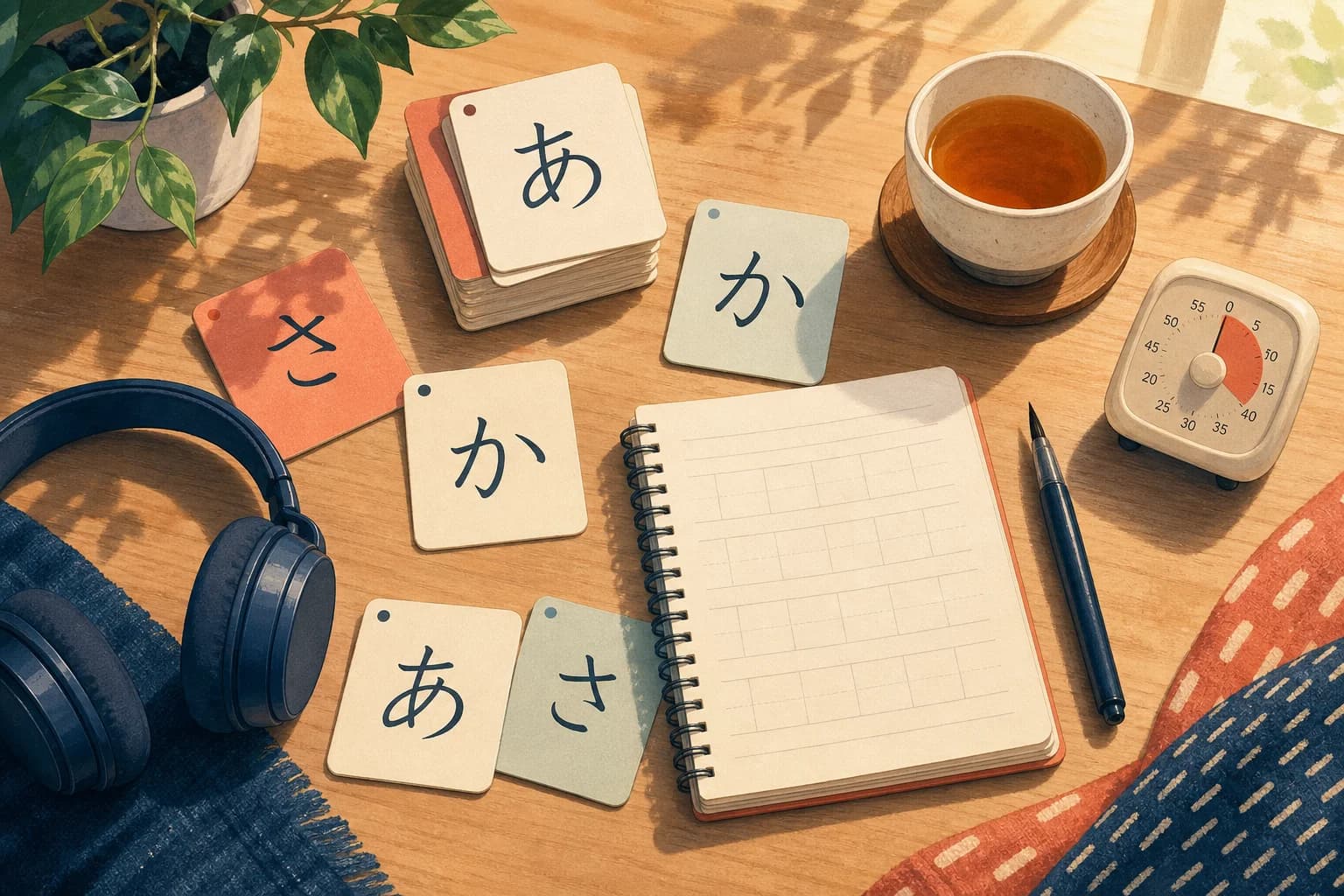
Contrast nearby forms, rebuild the message and retrieve the pattern again after the explanation is no longer visible.
The lesson shows how ために expresses a deliberate purpose, what form comes before it and why a nearby pattern may not fit the same intention. A changed prompt then removes the model sentence.
A grammar explanation becomes useful only when meaning, form, contrast and independent production continue to agree in a new context.
Describe what the pattern contributes to the message before naming its construction or English equivalent.
Attach the required particle, verb form or clause without leaving the completed example visible beside the prompt.
Explain why a similar pattern changes the register, certainty, relationship or sentence structure in the same situation.
Create a new sentence with a different person, time, reason or conclusion while preserving the intended effect.
Use the result to choose the next task. If you can recognise a highlighted pattern but cannot choose it from meaning alone, keep the practice contrastive. Fewer patterns studied deeply will support reading, listening and production better than a larger passive list.
One pattern learned deeply is more valuable than five explanations read passively.
Understand the situation and what the speaker wants before analysing the highlighted structure.
Identify what changes in meaning, register or construction when a similar form is used.
Change the person, time, reason or conclusion without leaving the target pattern visible.
The mapping fails as soon as the Japanese relationship changes.
Learn the role each particle marks and compare it inside full sentences.Familiarity with a rule can feel like the ability to use it.
Hide the example and rebuild a changed sentence from the intended meaning.Differences remain invisible when alternatives never share a context.
Practise confusing patterns side by side and write the boundary in plain language.Concrete coverage for this level or skill, connected to lessons, practice and review.
Browse N5, N4 and N3 patterns by level. Each entry connects structure, meaning, usage notes, example sentences and related forms without turning the explanation into a wall of terminology.
Transform dictionary forms into polite, negative, past and functional constructions. Feedback identifies the part of the form that needs correction.
Open and semi-open prompts ask you to construct the Japanese. Recurring word-order and grammar errors can move into the Mistake Lab for focused repair.
Direct answers about level, scope, support and offline learning.
Yes. Grammar content follows the same N5–N3 progression as the main course and links back to the lessons where each pattern is introduced.
You can use the grammar library and focused practice directly, while the guided course provides the clearest order and context.
Yes. Conjugation Dojo trains form changes, and sentence activities require you to choose the form a real message needs.
Plausible mistakes are explained rather than only marked wrong. Recurring error patterns can be saved for deliberate practice.
Learn, practise, review and complete the first three N5 units before deciding whether to unlock the full path to N3.