
Learning to ask someone to repeat in Japanese is useful before you can understand every answer. At a reception desk, you may recognize the greeting and still lose the room number. In a conversation, you may hear every sound but not know one word. Those are different problems, and they need different kinds of help. A polite request should make the next turn easier to understand, rather than simply start the whole conversation again.
This guide gives you a small repair routine: notice the gap, request the right change, check the important information and continue. You can practise with a partner and paper. The aim is not an uninterrupted performance. It is to keep an ordinary exchange accurate without pretending that a nod means you understood.
Ask someone to repeat in Japanese when the sound is missing
Before choosing a phrase, decide what disappeared. Did noise cover the answer? Did the words pass too quickly? Or was the sound clear while the meaning remained unknown? You do not need a formal diagnosis aloud. A quick private distinction helps you choose between another hearing and a different explanation.
Imagine asking for a room number. You catch the word for room but miss the number as a door closes. Another hearing is a sensible first request. By contrast, if the person repeats an unfamiliar noun perfectly and you still cannot connect it to anything, a third identical repetition may add little. Point to the object, ask for help with that word, or use a shared language.
Keep your target small. You may only need the number, the destination or the item being requested. You do not have to reconstruct every particle before moving on. For longer-term practice, separate the immediate communication task from a broader listening routine. That lets you solve today's exchange while saving a useful listening gap for later study.

Use one short, polite repetition request
A practical phrase is すみません。もういちど、お願いします。 The reading is sumimasen. Mō ichido, onegaishimasu. In this situation it means “Excuse me. Once more, please.” You are asking for another turn, not promising that you will understand it. Keep a short pause between getting attention and making the request.
The Japan Foundation's Irodori Starter lesson 2 models this request in beginner conversations. Use its audio to check the phrase rather than guessing pronunciation from romanization. Here, romanization is a temporary reading aid; the written Japanese and checked recording should remain your reference. Practise the request as one useful action, not as several isolated words to assemble under pressure.
Say it to a willing partner while maintaining normal conversational attention. Listen to the response instead of immediately rehearsing what you will say next. If a particular piece becomes clear, hold onto it. If the entire answer remains unclear, change the help you ask for. Repetition is a first tool, not a rule that the other person must keep repeating indefinitely.
Ask for slower speech only when speed is the problem
For a slower version, use もう少し、ゆっくり言ってください。 Read it mō sukoshi, yukkuri itte kudasai: “Please say it a little more slowly.” The request asks the speaker to adjust delivery. It does not ask them to replace an unknown expression with a familiar one. The same Irodori lesson provides a model for this distinction.
You can precede it with すみません when you need to attract attention politely. Avoid turning the exchange into a long apology. A clear short request leaves room for the speaker's response. The Japan Foundation Sydney classroom communication resource also offers expressions for requesting another hearing and slower speech; these are useful beginner models rather than a complete account of every social situation.
During practice, your partner should slow down enough to preserve a recognizable expression, not pronounce unrelated syllables with enormous gaps. Listen for the part you needed. If a slower answer still contains an unknown word, change strategy. Treat speed as one possible obstacle, rather than blaming every comprehension gap on how quickly Japanese is spoken.
Name the gap without claiming that everything is clear
よくわかりません。 is read yoku wakarimasen and means “I don't really understand” in this context. It signals a problem, but on its own it does not specify the help you need. Pair the signal with a repetition request or a slower-speech request when that is the next useful action.
If only one word is unfamiliar, you can point to a written version or indicate the relevant object before asking for assistance. You do not need an elaborate Japanese explanation of your own misunderstanding. With a teacher or practice partner, agree in advance that you can identify a troublesome word in your shared language. Then return to the Japanese exchange once its meaning is established.
Avoid treating a guessed word as a confirmed answer. Write a small question mark beside it on your note, or tell your partner that this is the uncertain part. For study afterward, record whether you lacked the meaning, the sound or the boundary between words. That distinction keeps your next practice task specific. It also prevents a vague “I am bad at listening” judgement from replacing an observable problem.

Check the information that changes your next action
Once you hear the missing piece, check what it allows you to do. Can you identify the correct room, choose the requested item or understand where the conversation is going? Successful repair depends on that information becoming usable. Producing the request smoothly is only the opening step.
In a practice exchange, have the speaker provide a short detail that you must use. Your response might be selecting the matching picture or pointing to a numbered card. The task should let both people see whether you understood, without requiring another difficult sentence immediately. Where appropriate in a real exchange, showing the written detail can also help establish a shared reference.
Be especially careful with details whose alternatives would lead to different actions. Do not accept a guessed appointment time or destination just to avoid another question. Ask for the detail again or seek a written confirmation. For anything consequential, use enough assistance to establish the facts. A language exercise is not a reason to leave practical uncertainty unresolved.
Keep your spoken sentence practice separate from this check at first. As you become comfortable, combine the two: request help, confirm the needed detail and give a short answer. You are building a sequence of actions, not collecting a longer list of rescue phrases.
Rehearse a conversation that actually needs repair
Prepare three short rounds with a willing partner. In the first, a sound is missed; in the second, delivery is too quick for your present level; in the third, a word is unfamiliar. Explain the roles beforehand. There is no need to manufacture stress, shout, or intentionally embarrass the learner. The difficulty should reveal which request is useful.
For the missed-sound round, your partner can say a familiar room number while you briefly look away, then repeat it after your request. For the speed round, use a short sentence whose vocabulary you already know. For the meaning round, choose one unfamiliar word and provide a picture or a shared-language explanation when you identify it. Keep the rest of the exchange manageable.
After each round, discuss one question: did the response supply the information you needed? If not, change the requested help and try once more. Do not score only politeness or pronunciation. A beautifully spoken request followed by another unexamined nod leaves the original gap in place.
Switch roles so you experience what makes a request easy to answer. Specific help is often easier to provide than an unspecified restart. Write down one adjustment for the next session, such as allowing a pause after the answer. Avoid increasing speed, sentence length and vocabulary difficulty all at once; you would lose track of the problem you were practising.
Change channel when another repetition does not help
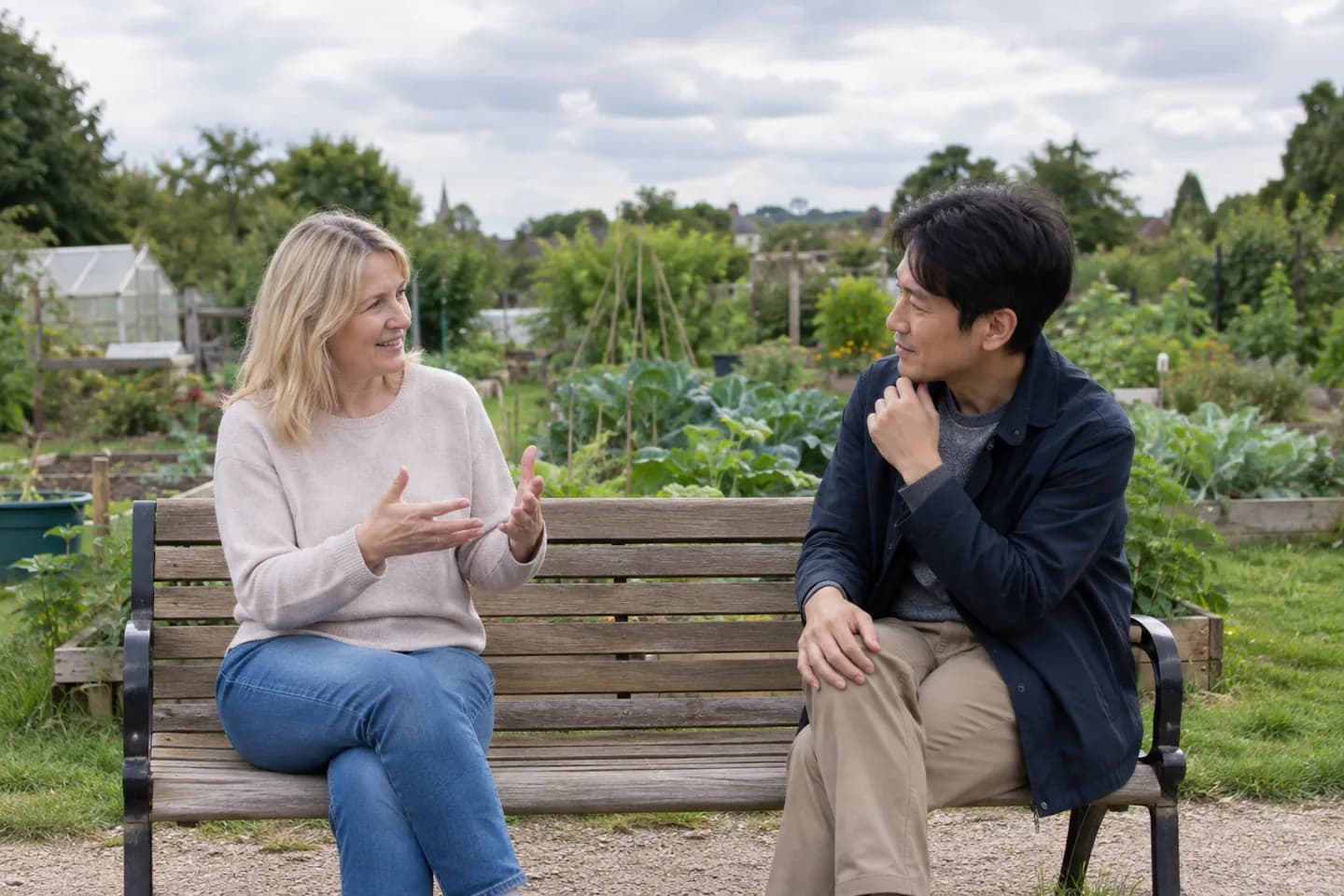
When two attempts have not resolved the gap, pause and change something. Move away from background noise if practical, ask the person to show the relevant written detail, or use a shared language. Two attempts are a practice boundary in this guide, not a universal rule of Japanese conversation. The important point is to avoid repeating an ineffective action without checking why it failed.
A written word may reveal a familiar expression that you could not separate in speech. It may also expose an entirely new word. Those outcomes call for different next steps: compare the checked sound with the spelling in the first case, and establish meaning before returning to audio in the second. Reading is support for the immediate exchange, not proof that listening has already improved.
If you cannot read the writing yet, ask for another kind of assistance. A picture, a gesture or a translation can be useful when both people understand what is being confirmed. Do not make a guess about an important instruction from a gesture alone. You can return to kana reading later with a clear example of where reading support would have helped.
Give the other person an easy way to finish the exchange. Once the needed information is clear, acknowledge that and proceed. If it remains unclear, be honest about the remaining uncertainty and seek suitable help. Repair should reduce confusion for both speakers, rather than turn the encounter into a prolonged test of the learner.
Turn one real gap into tomorrow's practice
After the conversation, save one small item rather than transcribing the whole encounter. Note the situation, the missing detail, the request you used and the response that finally helped. Do not record another person's voice without permission. A short written account is sufficient for deciding what to practise next.
If noise caused the problem, practise recognizing the checked expression in a clean recording before adding a more demanding setting. If delivery was too quick, use a short passage you understand and listen again while following its written version. If meaning was missing, learn that word in a relevant sentence before asking yourself to catch it in speech. Each task answers a different question.
At the next session, start with a fresh scenario so you cannot succeed only by remembering yesterday's answer. Keep the repair phrase available on paper if needed, then remove that support for one manageable attempt. Measure whether you requested useful help and confirmed the needed detail. That is a more concrete goal than deciding whether you now feel fluent.
KanaWay publishes this guide and remains an upcoming app. The routine above works without it: a checked model, a willing partner, a short note and a clear next action are enough. Stop the session once you have tested one useful change. In the next real conversation, your task is to recognize a gap and respond honestly, not to perform every phrase you have learned.