
You cannot read kana yet
Hiragana begins inside the course with optional rōmaji support that decreases as recognition grows.
Start from zero with a guided N5 course that introduces kana, vocabulary and grammar in the order you need them, then turns each lesson into reading, listening and your own answers.

Beginning Japanese can feel like starting four subjects at once: hiragana, katakana, kanji and a grammar system that does not behave like English. The problem is rarely a lack of resources. It is knowing what to learn first and how the pieces fit together.
Japanese begins with a carefully ordered N5 path. Kana arrives alongside useful words, grammar appears inside situations, and review brings the same language back in more than one form. You build a foundation without spending weeks preparing to begin the real language.
This path is built for a true beginner, a returning learner with gaps or someone who has collected resources but never found a reliable order.
Hiragana begins inside the course with optional rōmaji support that decreases as recognition grows.
The course reconnects vocabulary, grammar and listening around practical unit goals.
Use placement and review to keep secure knowledge while repairing gaps in the N5 foundation.
You do not need to finish an entire script chart before meeting useful Japanese. The course introduces just enough support for the next real task.
A beginner path that removes support at the right time.
Move from rōmaji to direct hiragana and katakana recognition, with support available while the scripts are new.
Learn particles, word order and verb forms through messages you might actually need to understand or express.
Connect written words to Japanese pronunciation through lesson audio, listening questions and dictation.
Follow the next lesson, clear due reviews or choose one focused practice mode when a skill needs attention.
Practise hiragana and katakana directly, then meet the same characters inside words and sentences.
A new form is explained, contrasted with likely mistakes and used before the lesson ends.
Support is gradually removed so recognition can become independent reading and production.
Spaced repetition brings back fragile knowledge sooner while secure items receive more space.
You do not need to finish an entire script chart before meeting useful Japanese. The course introduces just enough support for the next real task.
Hiragana, greetings, names and Japanese sound
Character recognition, audio and short introductions
Read and adapt a basic self-introduction
Time, places, food, people and daily actions
Particles, polite forms and guided exchanges
Ask and answer concrete everyday questions
Past, negatives, adjectives, counters and connected basics
Reading, listening, kanji and practical missions
Follow and create short messages without a script
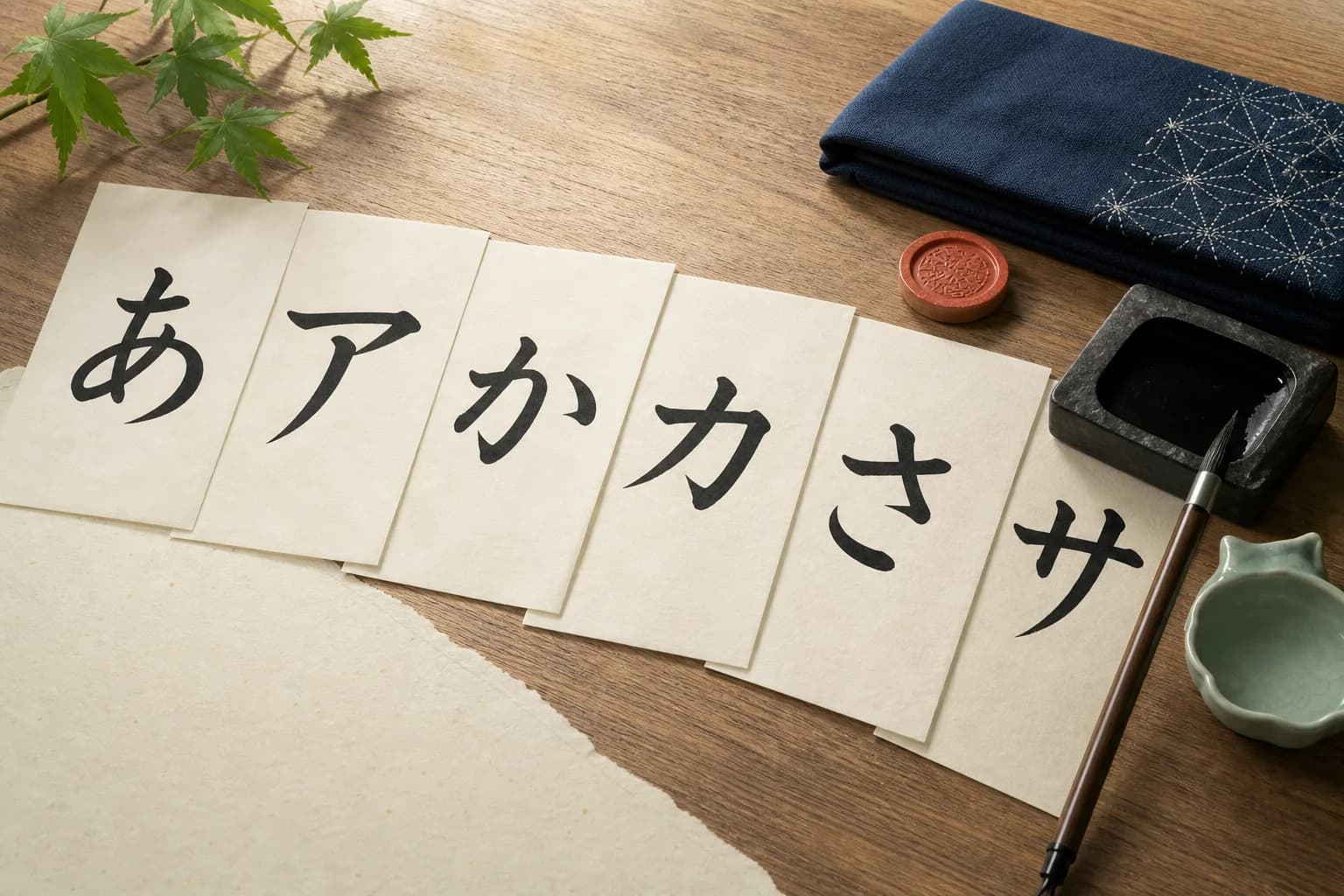
Kana and beginner grammar become easier to retain when they immediately unlock greetings, signs, directions and everyday exchanges.
The lesson begins with meaning and pronunciation, connects はじめまして to the situation where it belongs, and shows how です completes a polite introduction. Later prompts change the name, question or reply so you have to build the response yourself.
Early progress should reduce dependence on rōmaji and model answers while increasing the amount of Japanese you can understand as a complete message.
Reach the sound from hiragana or katakana without silently converting every character into the Latin alphabet first.
Choose the needed word order, particle and polite form when the person, time or destination changes.
Understand a greeting, introduction, simple question or immediate need without requiring every line to remain on screen.
Introduce yourself, ask for information or describe a routine using remembered language and only selective support.
Use the result to choose the next task. A beginner does not need perfect speed or a large kanji total. The stronger milestone is being able to read, hear and construct a small set of useful messages without the original example beside you.
Consistency matters more than occasional long sessions. Use the full routine when possible and keep the review step on shorter days.
Clear a small due set, speaking the answer where possible instead of tapping through recognition only.
Follow one goal from explanation through practice and finish the changed sentence or mission.
Write one sentence or recall five items with rōmaji and translations hidden.
Weeks of isolated charts can drain momentum and delay meaningful language.
Learn kana alongside first words, grammar and audio, then reduce rōmaji gradually.A fixed script works until one detail changes.
Change the person, time, place or answer and rebuild the sentence.Different orders and terminology make progress difficult to see.
Use one main path and keep other resources for a clearly defined gap.Concrete coverage for this level or skill, connected to lessons, practice and review.
The N5 path covers kana, introductions, numbers and time, family, food, shopping, places, directions, everyday actions and the grammar needed to connect them. Each unit ends with a practical mission rather than an isolated word total.
Kanji appears with words you already have a reason to learn. Form, reading, meaning and writing practice stay connected, so characters do not become a separate wall of symbols.
The same course structure continues into N4 and N3. Sentences become longer, situations become less predictable and the focus moves from immediate needs toward explanations, stories, register and nuance.
Direct answers about level, scope, support and offline learning.
No. Hiragana and katakana are part of the beginner path. Optional rōmaji helps at first, then fades as direct kana recognition develops.
A normal lesson is designed for around 8–12 focused minutes. Due reviews or a short kana session can keep momentum on busier days.
The first three N5 units contain 15 full lessons and are free, together with the placement test, dictionary, daily goals and core practice.
Lessons, progress, reviews, saved words and the dictionary are designed for offline study. Pronunciation uses the Japanese voice available on your device.
Learn, practise, review and complete the first three N5 units before deciding whether to unlock the full path to N3.