
You know it after seeing the answer
Use kana, kanji or vocabulary recall with the clue removed before you respond.
Choose a focused session for kana, kanji, vocabulary, conjugation, reading, listening or sentence production — all connected to the language in your N5–N3 course.
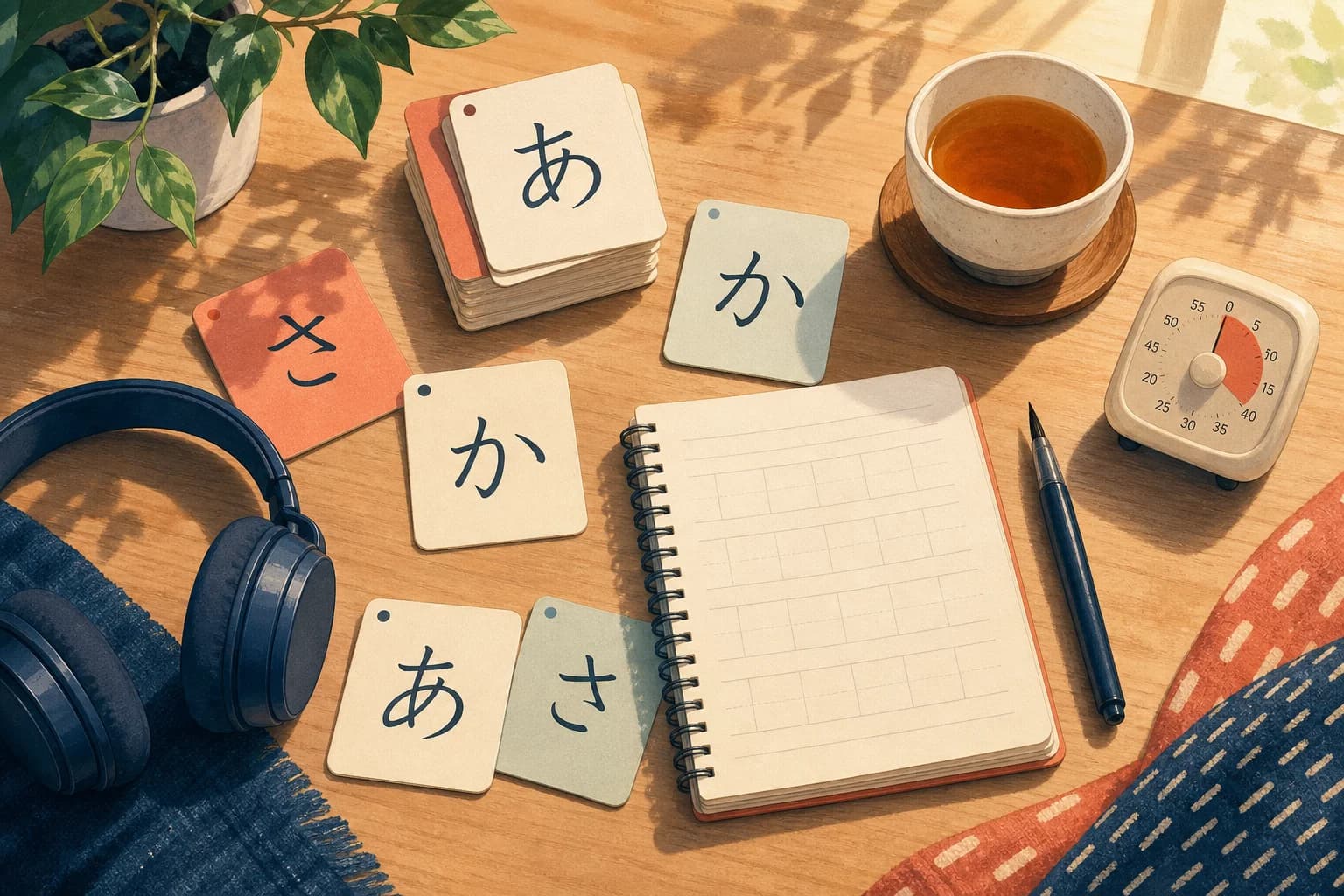
A wrong Japanese answer can have very different causes. You may know a word but not recognise it in audio, understand a verb in dictionary form but miss its conjugation, or read a sentence that you could not build independently.
Focused practice separates those problems long enough to improve them. Because every mode shares the same course language and progress system, the skill work returns to complete reading, listening and communication instead of becoming a collection of unrelated mini-games.
A useful practice mode answers a specific problem: what did you fail to recognise, retrieve, hear, read or build?
Use kana, kanji or vocabulary recall with the clue removed before you respond.
Use graded reading or listening that requires the situation, purpose and relevant detail.
Use dictation, conjugation and sentence building with changed prompts.
The same Japanese should move through several forms. That is how a familiar flashcard becomes language you can recognise in context and retrieve independently.
A short practice loop with a clear purpose.
Strengthen hiragana, katakana and commonly confused character pairs until recognition becomes automatic.
Recall vocabulary, kanji readings and conjugations without relying on a visible list of answers.
Practise graded Japanese reading and listening with support that can be revealed only when needed.
Move beyond recognition with dictation, sentence building and changed prompts that require active Japanese.
Open one skill directly or follow a recommendation based on recent lesson and review performance.
Read, listen or answer before opening readings, translations or grammar support.
Compare the missed sound, character, form or sentence segment instead of seeing only correct or incorrect.
Fragile items reappear sooner through spaced repetition; secure knowledge receives more distance.
The same Japanese should move through several forms. That is how a familiar flashcard becomes language you can recognise in context and retrieve independently.
Kana, kanji, vocabulary and readings
Contrast, recall, writing trace and SRS
Recognise the item without rōmaji or answer choices
Grammar selection and verb or adjective endings
Conjugation, sentence completion and transformation
Choose and build the form that fits a changed context
Reading, listening and active production
Stories, dialogues, dictation and missions
Understand the point and produce a relevant response
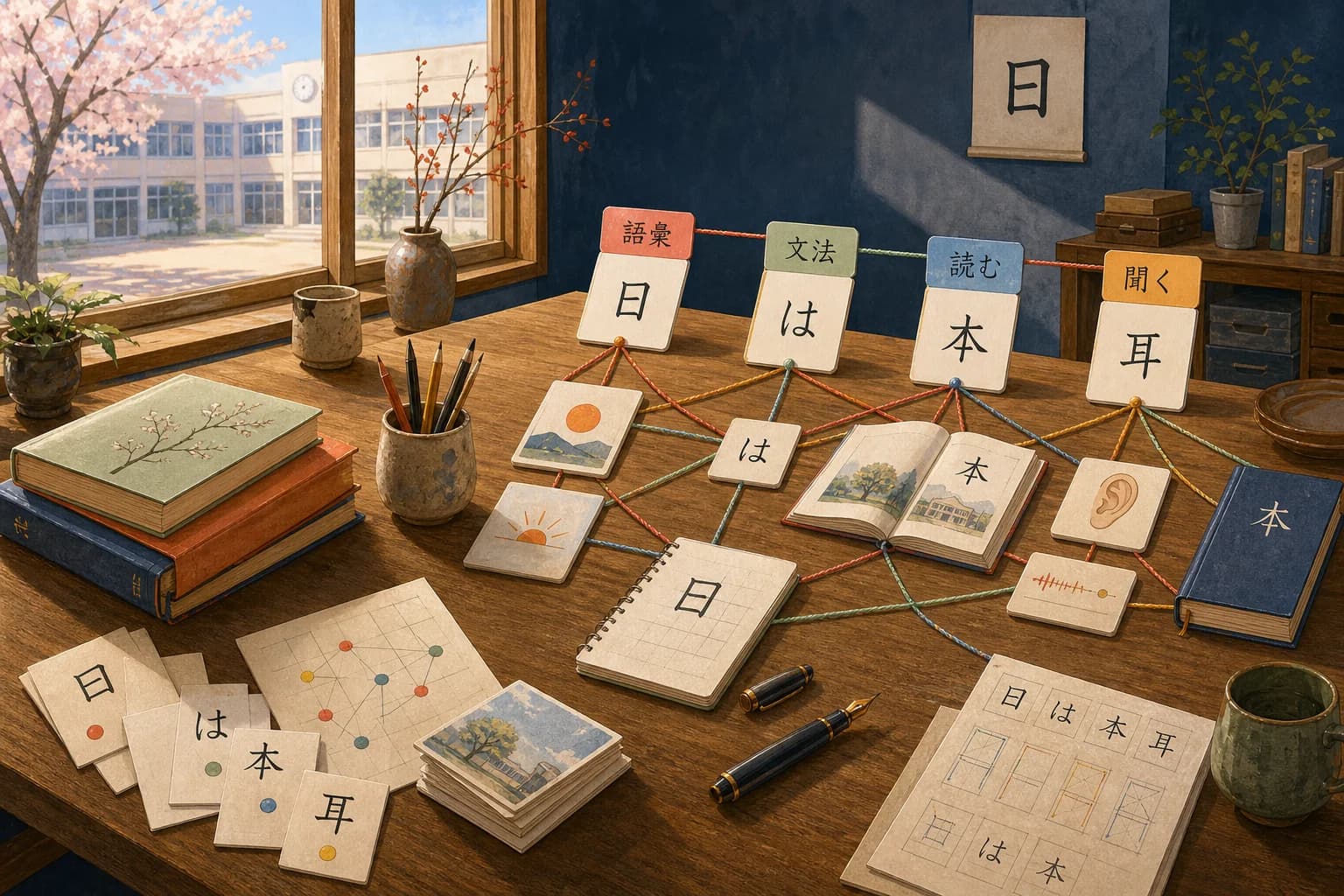
A missed sound, reading, grammar choice or sentence build should lead to a different kind of repair—not another random drill.
A short session can target the exact problem behind a mistake: a similar kana pair, a kanji reading, a verb ending, a missed sound or a sentence you recognised but could not produce.
A high activity count can hide a repeated mistake. Finish a focused session with evidence that the failed connection has changed.
Separate a meaning gap from a missed reading, sound, conjugation or production problem before choosing another exercise.
Retrieve the kana, word, form or sentence yourself so familiarity with the answer does not inflate the result.
State the decisive sound, character feature, particle relationship or grammar contrast instead of only copying the corrected answer.
Complete a nearby prompt with a different person, time, word or intention to prove that the correction can travel.
Use the result to choose the next task. The final changed prompt matters more than the number of taps. If it still fails, keep the item focused and return later through spaced review rather than repeating it immediately until it feels familiar.
Short practice works when the session has one target and ends with evidence that the target improved.
Choose one observable gap: for example, long vowels in audio or the difference between ている and the simple present.
Work through a small set where the confusing alternatives appear close enough to compare.
Finish with one sentence, dictation line or short passage where the repaired skill matters.
Fast correct answers feel productive but may not change the weakest skill.
Let recent errors choose the session, then finish once accuracy becomes stable.Recognition can hide an inability to retrieve the same word or form.
Alternate selection tasks with typing, dictation and sentence building.Unrelated drills create scores without connected language growth.
Practise the vocabulary and grammar from your current learning path.Concrete coverage for this level or skill, connected to lessons, practice and review.
Train script recognition, kanji meaning and readings, course vocabulary and personally saved dictionary words. Writing traces, minimal contrasts and active recall strengthen different parts of the memory.
Compare nearby patterns, choose forms in context and build changed sentences. Conjugation practice isolates endings without pretending that verbs live outside complete messages.
Use graded stories, short texts, dialogues and dictation from N5 to N3. Optional readings and translations support the attempt without replacing it.
Direct answers about level, scope, support and offline learning.
You can focus on hiragana, katakana, kanji, vocabulary, grammar, conjugation, reading, listening, dictation and sentence production.
Yes. Beginner practice starts with kana, high-frequency words and short N5 sentences, then becomes more independent as support fades.
Yes. Course items and saved words return according to performance so weak knowledge receives attention without making every session a full review.
Core skill practice, course review, reading, dictionary lookup and device pronunciation are designed for offline use.
Learn, practise, review and complete the first three N5 units before deciding whether to unlock the full path to N3.