
Japanese script is completely new
Learn small groups by sound and shape, then recognise them inside real beginner words.
Build direct recognition of both Japanese kana systems with pronunciation, matching and writing support, then meet the same characters inside useful beginner words and sentences.
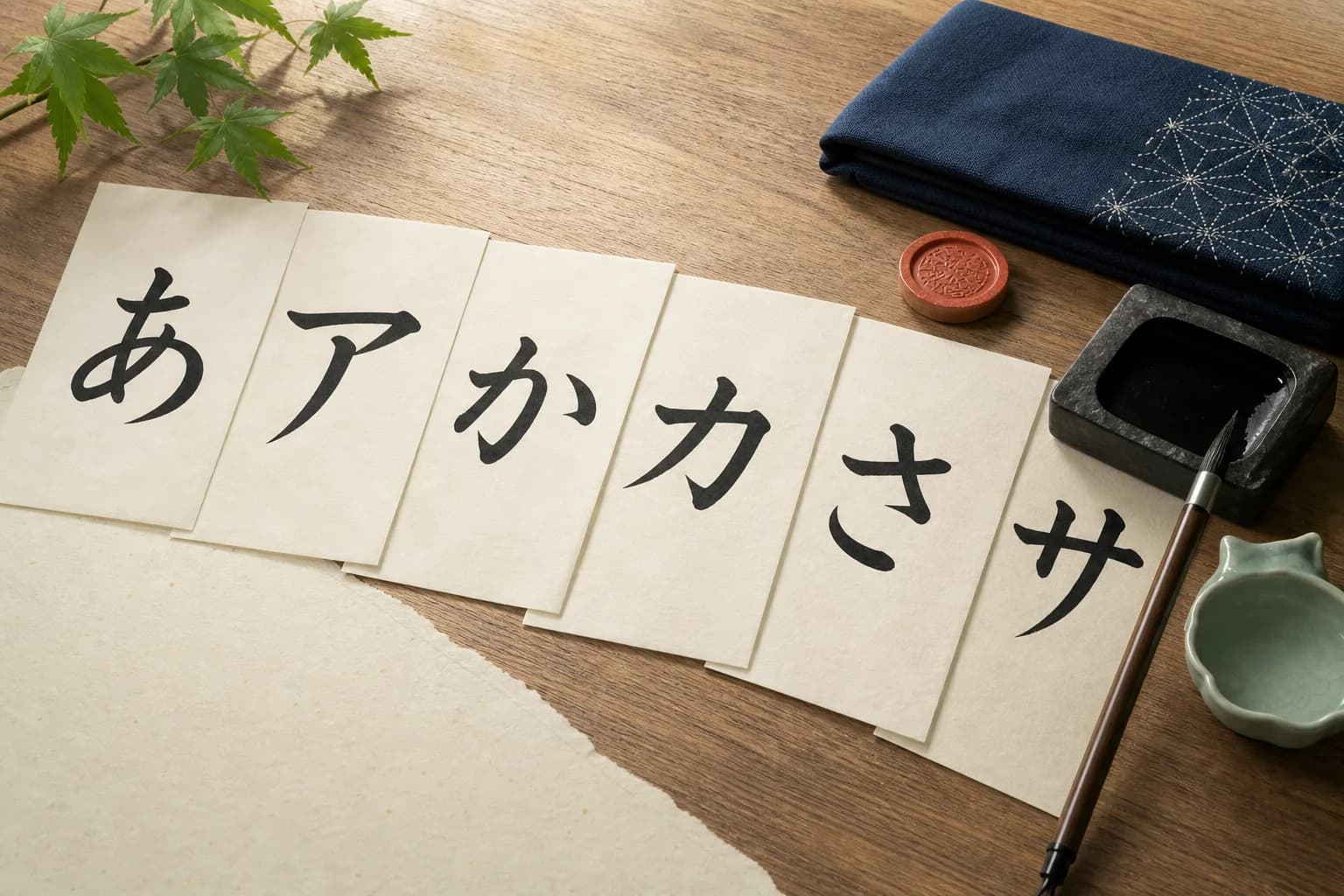
Hiragana and katakana are the first writing systems most Japanese beginners meet. Memorising a chart is helpful, but reading requires you to recognise the characters quickly when they appear in a word rather than reciting them in chart order.
Kana Match builds that direct connection. The beginner course then reuses the scripts inside vocabulary, grammar and sentences so kana practice immediately leads into Japanese you can understand.
This path starts from zero and also helps learners who know the charts but still read slowly or confuse similar characters.
Learn small groups by sound and shape, then recognise them inside real beginner words.
Practise katakana early enough that it does not become a second beginner phase later.
Timed recognition, contrasts and word reading move kana from recall to automatic processing.
The goal is not reciting a chart. It is recognising sound accurately while your attention remains available for the word and sentence.
How characters become sounds you recognise automatically.
Read the core script used for grammar endings and many native Japanese words.
Handle loanwords, names, emphasis and the sound combinations common in foreign vocabulary.
Use device pronunciation to reinforce the sound represented by each kana.
Move from single-character matching to vocabulary and complete beginner sentences.
Focus on a small character set rather than repeatedly scanning the entire chart.
Kana Match removes chart position as a clue and trains direct recognition.
Stroke guidance helps separate characters that look similar and reinforces their structure.
New characters reappear in course words, grammar examples and reading so recognition becomes useful.
The goal is not reciting a chart. It is recognising sound accurately while your attention remains available for the word and sentence.
Basic hiragana and katakana in small sound groups
Recognition, audio matching and optional tracing
Name the sound without using alphabet position as a clue
Dakuten, handakuten, combinations and small っ
Minimal contrasts such as かき and かぎ
Notice the character feature that changes the word
Long vowels, loanwords and complete beginner vocabulary
Word bursts and short sentence reading
Read familiar kana words without converting through rōmaji

Short words and messages stop kana from becoming a chart you can recite but still cannot read fluently.
Dakuten changes か to が and creates a different word. Kana practice trains the visual and sound contrast, then course vocabulary places both forms where meaning makes the difference memorable.
Kana is ready when recognition is direct, sound details remain accurate and familiar words no longer require character-by-character decoding.
Recognise hiragana and katakana without relying on chart order, matching positions or a visible rōmaji cue.
Distinguish pairs such as シ and ツ while also noticing small っ, combinations and long vowels that change a word.
Group characters into a word and reach its pronunciation smoothly instead of restarting after every kana.
Read a short beginner line accurately enough that the situation and grammar remain in working memory.
Use the result to choose the next task. Speed grows through frequent accurate reading, not rushed guessing. Reduce rōmaji as soon as a sound group is stable, then keep kana active through vocabulary and sentences rather than isolated chart review.
Short daily recognition builds speed better than repeatedly copying the complete chart.
Mix old and new characters so position on the chart cannot reveal the answer.
Place ぬ and め, シ and ツ, or another personal confusion side by side with sound.
Finish with vocabulary that uses the same kana, including one line without rōmaji.
Sequence memory can answer even when the character itself is not secure.
Use shuffled recognition and mixed hiragana-katakana review.Missing っ, ゃ or a long vowel can change the word completely.
Practise sound contrasts inside vocabulary, not as a footnote.The familiar alphabet captures attention before kana has a chance.
Hide rōmaji by default and reveal it only after attempting the Japanese.Concrete coverage for this level or skill, connected to lessons, practice and review.
Rōmaji is optional while the scripts are unfamiliar. It steps back deliberately as recognition improves, preventing the Latin spelling from becoming the permanent route to Japanese sound.
Kana practice includes voiced sounds and combinations, while course vocabulary shows how they behave inside real words.
Continue into N5 vocabulary, grammar and first kanji. You do not need perfect speed before beginning sentences; reading improves through continued use.
Direct answers about level, scope, support and offline learning.
Hiragana usually comes first because it appears throughout beginner grammar, but the course introduces both and continues to mix them in practice.
Yes. Rōmaji is optional, so you can switch it off immediately or let it fade as your recognition improves.
Writing support connects each character to its stroke sequence while matching practice develops fast recognition.
The pace varies. The goal is not only reciting both charts but recognising kana reliably inside words, which develops through continued course use.
Learn, practise, review and complete the first three N5 units before deciding whether to unlock the full path to N3.