Japanese pronunciation practice often starts with consonants or pitch, yet a smaller timing choice can change which word a listener hears. A short vowel takes one beat; a long vowel occupies two. If the second beat disappears, おばあさん can drift toward おばさん, and ビール can sound closer to ビル. The mouth shape is not the main difference. The sound has to remain available for the extra unit of time while the sentence keeps moving.
This free routine turns that idea into an action you can repeat. You will first hear the contrast, then count it, imitate it, record it and use it inside a sentence. The method works with any clear model audio. KanaWay is still upcoming, but its connected lesson, listening, practice and review flow is designed to keep this kind of sound detail attached to useful words rather than leaving it in a separate pronunciation notebook.
Japanese pronunciation practice begins with two equal beats
Japanese timing is commonly described with morae: small rhythmic units that tend to receive comparable time. A simple kana such as か usually represents one mora. A long vowel lasts for two morae, even when the spelling does not show two identical vowel letters. The Japan Foundation's teaching notes illustrate the principle with さとう and explain that a long vowel takes two haku, or beats. That is the useful beginner rule: do not merely make the vowel vaguely slower; give it a second place in the rhythm.
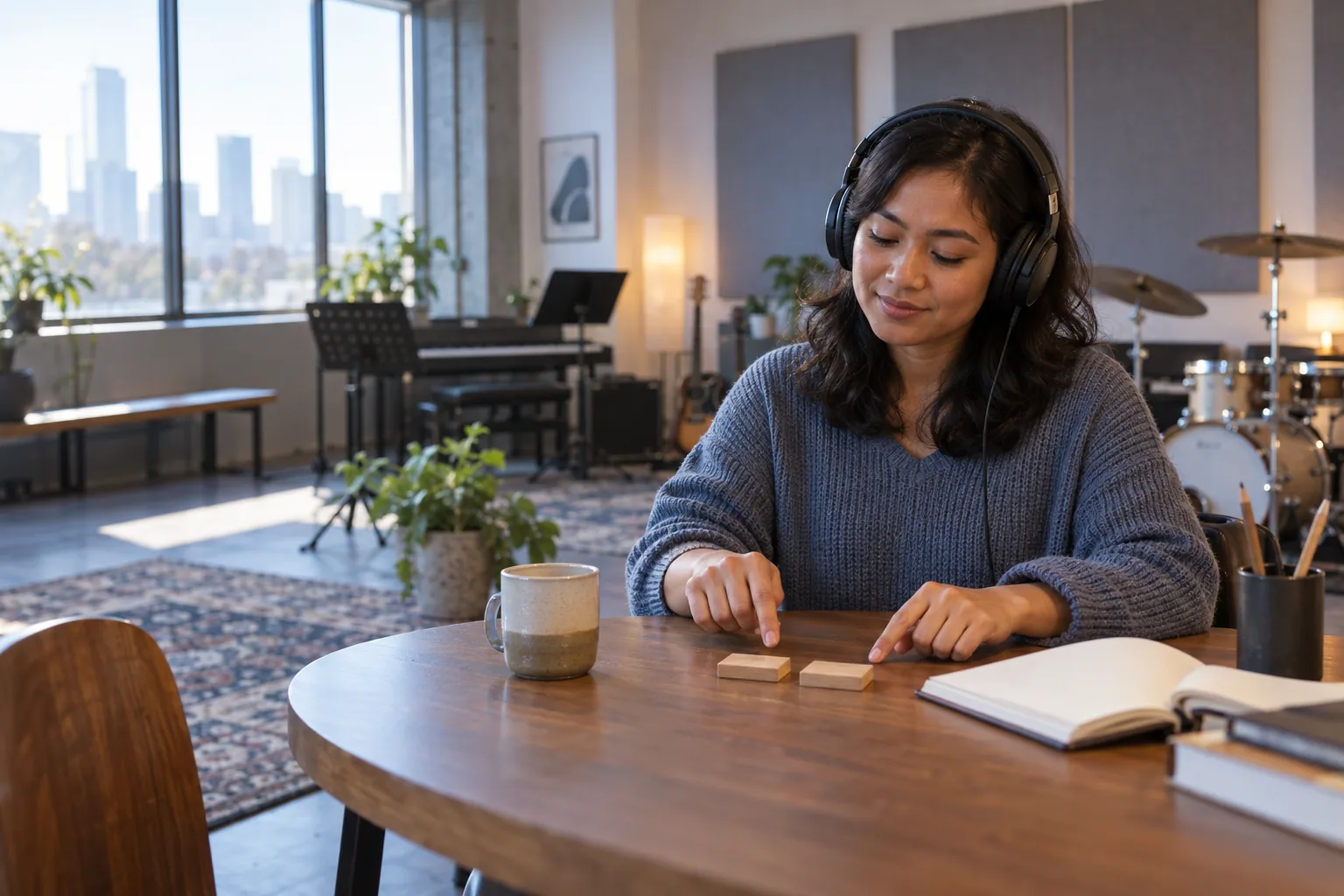
Try a neutral four-beat pulse with your fingers. Say さ・と・う across three taps, keeping the final two morae connected as one long /o/ sound in normal pronunciation. Then say お・ば・あ・さ・ん across five. The taps are scaffolding, not a performance style. They make the missing duration visible. Once the spacing is stable, remove the hand movement and keep the same internal pulse. This trains timing without forcing an unnatural pause between written kana.
- One short vowel occupies one rhythmic place.
- One long vowel occupies two rhythmic places.
- The two places stay connected; do not insert a stop between them.
Hear the duration before trying to copy the voice
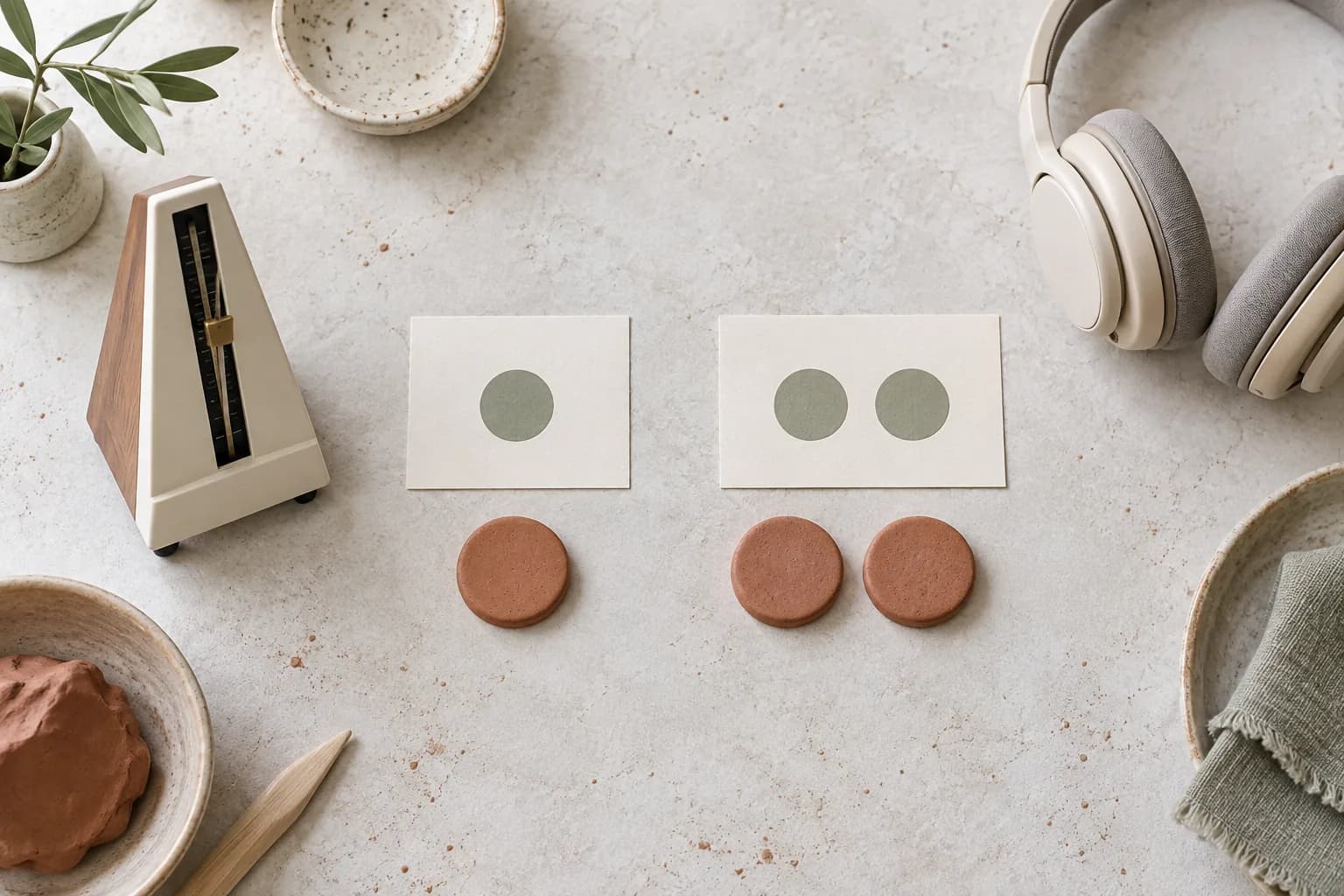
Imitation becomes guesswork when you have not identified what changes. Start with a short-versus-long pair and ignore pitch, loudness and speaker personality for the first pass. Ask only whether the vowel fills one beat or two. Play the pair in both orders, leave a short gap, and point to one token or two before you repeat anything. Ten accurate listening decisions teach more than a minute of automatic shadowing.
Use real words that differ clearly in vowel length: ビル, building, and ビール, beer; おじさん, uncle, and おじいさん, grandfather; ゆき, snow, and ゆうき, courage. Meanings prevent the exercise from becoming empty sound sorting. They also reveal why the contrast matters. Keep the set small enough to notice uncertainty. If you miss a pair, replay the complete pair rather than looping only the difficult word, because the contrast supplies the reference your ear needs.
Read the spelling as a timing map, not an English clue
Kana spelling tells you where to look, but long vowels do not follow one visual pattern. In hiragana, /aa/ often appears with あ, as in おばあさん, and /ii/ with い, as in おじいさん. Long /uu/ can appear with う, as in くうき. Many words written with an えい sequence are commonly pronounced with a long /e/, and many written おう sequences with a long /o/, such as せんせい and がっこう. There are also important spellings such as おおきい. In katakana, the long-vowel mark ー makes the extra beat much easier to see, as in ビール.
Do not turn those tendencies into a rule that rewrites every vowel sequence. Japanese also has adjacent vowels that may remain perceptibly separate, and pronunciation can vary by word, speaking style and region. Learn spelling, audio and meaning together. Mark the long portion with a simple underline or two dots, listen to a reliable recording, and store the whole word. A romaji macron can summarize length, but kana is the durable guide you will meet in actual reading.
Build a minimal-pair ladder from listening to meaning
A minimal pair should lead somewhere. Use four steps: identify the sound, choose the written word, retrieve the meaning and place the word in a short phrase. For ビル and ビール, hear the audio without text first. Next choose between the two kana forms. Then say the meaning before it appears. Finally complete a tiny line such as ビルに入ります or ビールを飲みます. The grammar stays easy so timing remains the focus.
Reverse the direction on the next round. Begin with the meaning or an image, produce the Japanese word, and only then check the audio. Recognition proves that the ear can separate the pair; production proves that you can preserve the contrast without a model playing at the same time. Keep a note of the direction that failed. A learner who can hear おばあさん but shortens it while speaking needs a different next task from someone who cannot yet hear the extra mora.
Use an app-assisted loop without surrendering the decision
An app can organize repetition, but your ear still has to make the decision. A useful loop begins with one explained contrast, continues with a listening choice, asks for a spoken or typed response, gives the model again and schedules the word for later review. KanaWay is being built around this connection between lesson, practice, recall and use. Its role is to keep the word, audio, meaning and later encounter together, not to award points for pressing play.
For long vowels, pause before every reveal. Decide one or two beats, give the answer, then compare. If the word returns in a reading or listening lesson, notice the same timing inside a new sentence instead of treating it as a brand-new fact. Save only pairs that genuinely compete in your perception or production. A small personal contrast list is more useful than a generic bank of fifty words you already pronounce clearly.
- Explain the timing contrast in one sentence.
- Make a listening decision before seeing the spelling.
- Produce the word without talking over the model.
- Review the weak direction later in a different sentence.
Record one clean attempt and compare the middle, not the mood
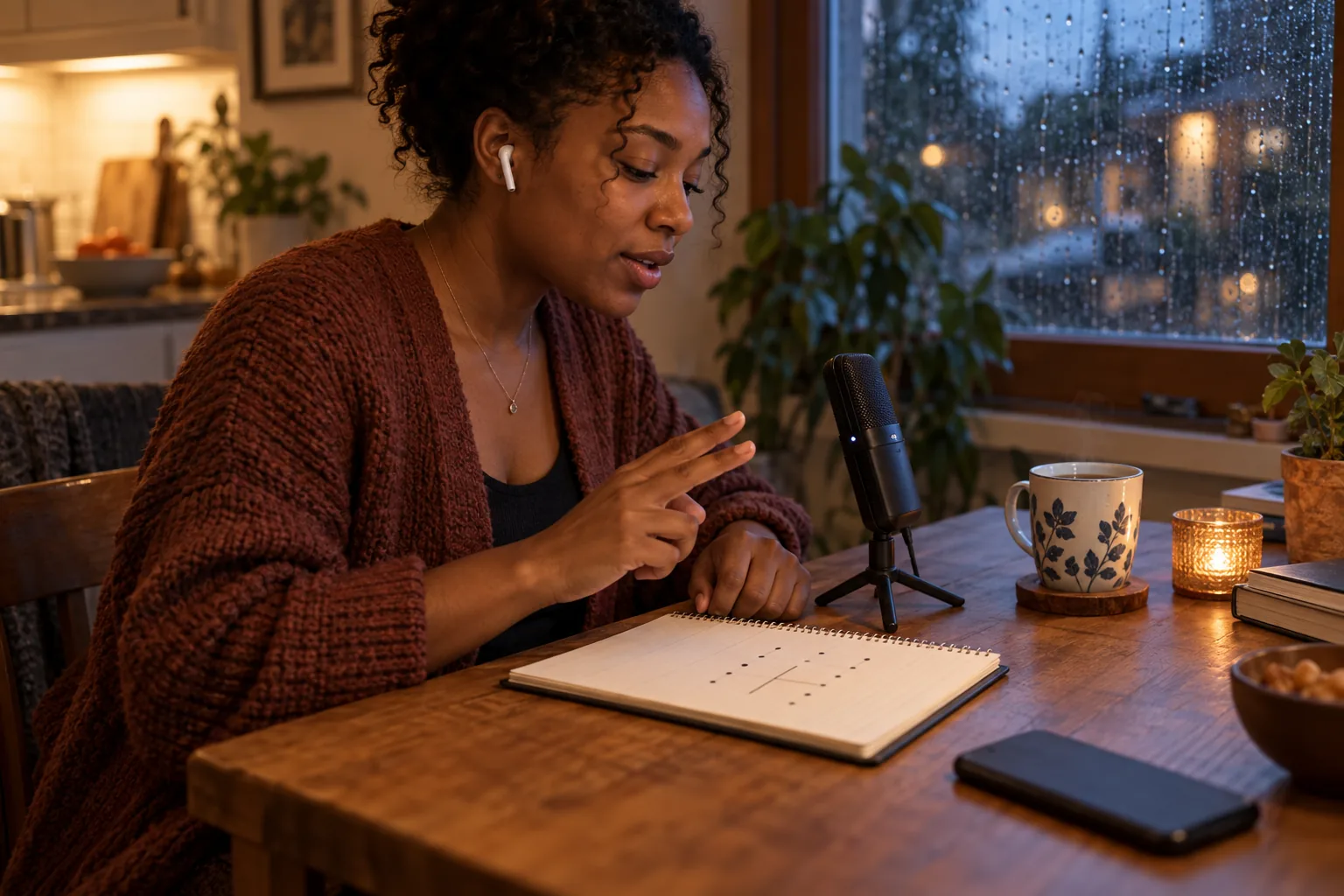
Self-recording helps only when the comparison is specific. Choose one word, listen once or twice, put the model away and record a single natural attempt. Compare the beginning, the vowel duration and the following consonant. Do not reject the recording because your voice sounds unfamiliar or your accent is not identical. The question is narrower: did the long vowel retain two timing places, and did the rest of the word continue without an inserted pause?
A simple visual check can help if your recorder shows a waveform, but do not confuse a larger shape with correct pronunciation. Volume, microphone distance and background noise all change the picture. Trust repeated listening and the beat count first. Record the short and long member in the same session, using the same pace. Then put them into two parallel phrases. This gives you a controlled contrast while keeping the final target connected speech rather than an isolated laboratory sound.
Protect the long vowel when the sentence gets faster
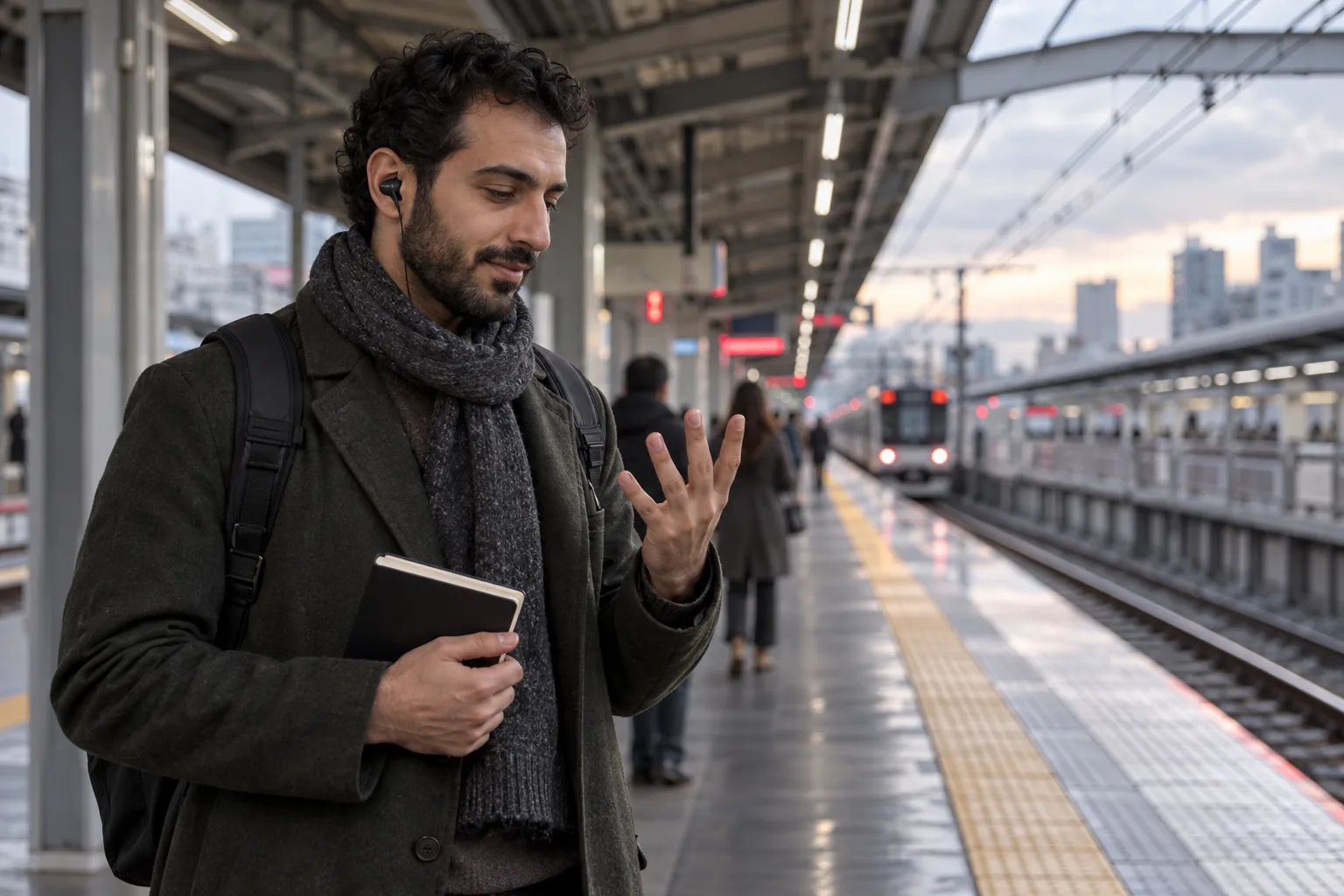
A learner may produce a perfect long vowel alone and lose it inside a sentence. The repair is not simply to speak everything slowly. Build outward in layers. Say ゆうき, then ゆうきが, then ゆうきがあります, and finally place the phrase in a complete response. Keep the two beats of ゆう while the surrounding material grows. If it collapses, return one layer rather than beginning the entire lesson again.
Practise with a steady, comfortable tempo before increasing speed. Long does not mean stressed, shouted or dramatically stretched. It means the vowel occupies the required timing while prominence and pitch follow the phrase. Alternate one careful version with one conversational version, and stop when accuracy deteriorates. Five controlled sentences build a more reliable habit than twenty rushed repetitions. In listening, tap only the target word so you learn to locate its timing inside a continuous stream.
The goal is not a theatrical long sound. It is a quiet second beat that survives normal speech.
Follow a seven-day free long-vowel practice plan
Day one is listening: choose three contrast pairs and decide short or long before viewing kana. Day two adds beat counting with tokens or fingers. On day three, read the spelling, hide it and produce each word from its meaning. Day four places the same words in short parallel phrases. Day five uses self-recording and one precise correction. Day six moves the words into an unfamiliar audio or reading example. On day seven, test all directions without warm-up and keep only the unstable items for the next week.
Ten minutes per day is enough for this narrow target. Spend two minutes hearing, two counting, two producing, two using sentences and two reviewing errors. Rotate words instead of increasing the pile: ビル/ビール, おじさん/おじいさん and ゆき/ゆうき already cover katakana, hiragana and different vowel spellings. Add a new pair only when an old one works in both listening and production. This makes the free plan measurable without pretending pronunciation becomes finished after seven days.

Know when the contrast is ready to leave the drill
A pair is becoming usable when you can hear it from different speakers, choose the correct kana without delay, produce the word from meaning, and preserve the duration in a new sentence. One lucky recording is not enough, but perfection across every voice is not required. Look for stable performance on several days and in both directions. If the problem returns after a week, shorten the set and restore the listening contrast before adding more repetition.
Watch for three common detours. Do not replace length with extra loudness. Do not pause between the two morae as if they were separate words. Do not rely permanently on a drawn line or macron that disappears in ordinary text. The best Japanese pronunciation practice gradually removes those supports. You still know which vowel is long because spelling, sound, meaning and sentence experience point to the same word—and because your internal timing leaves room for the second beat.