Free Japanese reading practice often becomes translation practice by accident. You read one word, search for an English equivalent, write it above the line and repeat until the Japanese sentence is buried under notes. The final translation may look polished, yet you still cannot say who did what, which phrase modifies which noun or why the verb at the end changes the whole message. The problem is not that translation is forbidden. It is that translating too early replaces the reading decisions your Japanese needs to learn.
A better routine moves from situation to structure, then from structure to meaning. You identify the kind of text, locate the final predicate, group related words, use particles as relationship markers and postpone the dictionary until one unknown item truly blocks the task. This guide applies that process to real sentences and shows how KanaWay's upcoming reading workflow is designed to keep the passes connected. You can also follow every step now with any short graded passage and a dependable dictionary.
Begin free Japanese reading practice with a purpose
Before reading the first character, decide what the text is for. A station notice may tell you where to go or what changed. A message may propose a time, explain a delay or ask for a reply. A menu, event poster and short story demand different kinds of attention. Look at the setting, format, image, headings, repeated numbers and visible names. Then ask one modest question: What decision or main event should I understand? A clear purpose stops every unknown word from feeling equally urgent.
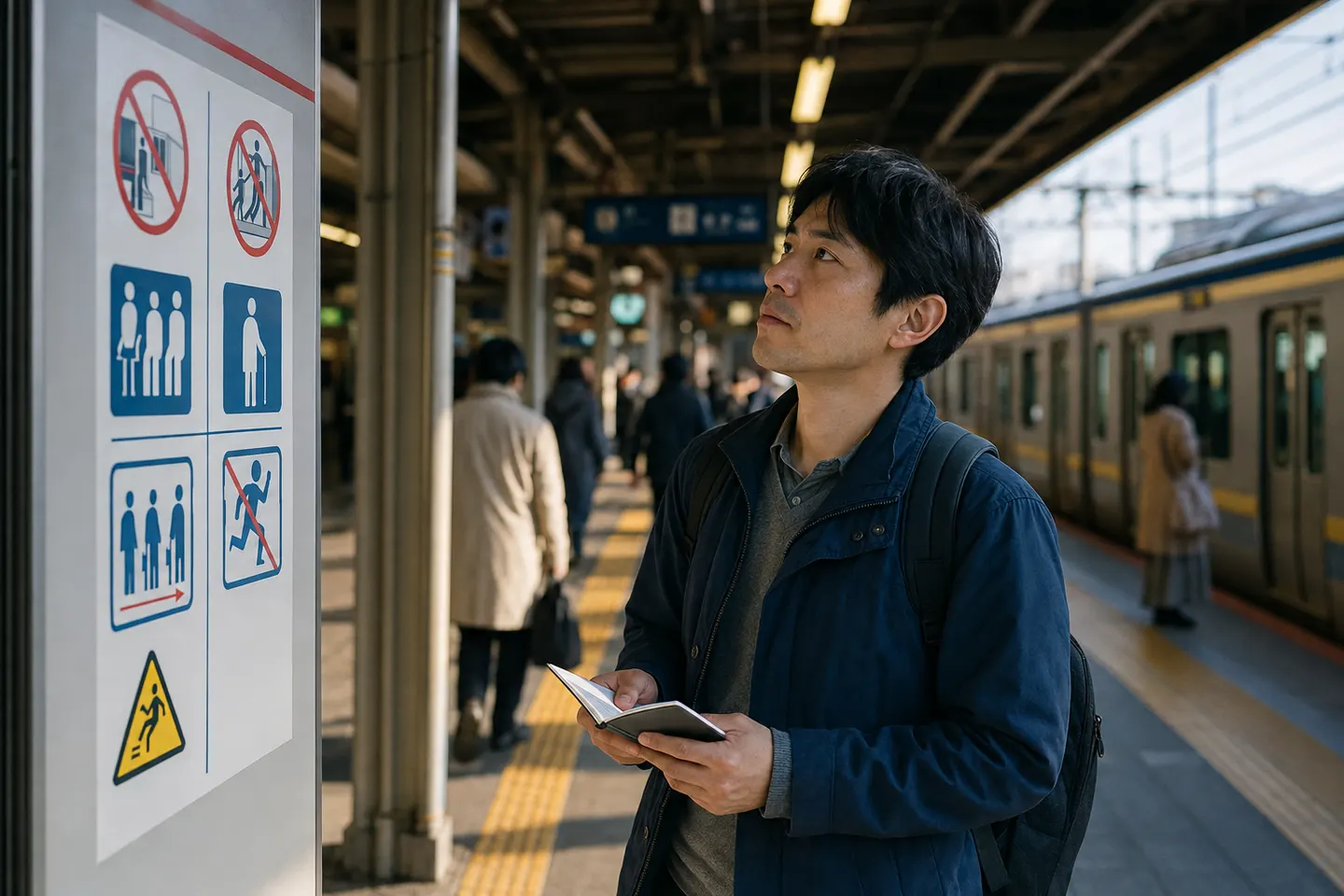
Consider a notice beside a train platform. Even before you decode its full wording, arrows, times, platform numbers and the surrounding situation narrow the possibilities. Your first pass might only establish that a train is delayed and passengers should use another platform. That is already comprehension. A complete English sentence is not required to act correctly. Once the main function is secure, details such as cause, duration or exception become easier to place because they attach to an understood situation.
Find the final predicate before building a translation
Japanese sentences often place the main predicate at the end. It may be a verb, an adjective or a noun followed by a copula. Start there because it tells you what kind of statement the sentence makes and whether it is positive, negative, past, tentative or polite. In 雨が降っていたので、駅までバスで行きました, ame ga futte ita node, eki made basu de ikimashita, the final 行きました means went. The sentence is ultimately about a completed movement, not simply rain, a station or a bus.
Work backward only far enough to find what belongs to that predicate. 駅まで marks the endpoint, バスで marks the means and the omitted subject is understood from context. 雨が降っていたので supplies the reason: because it was raining. You do not need to compose elegant English while reading. Hold a compact Japanese map instead: rain was continuing, therefore, station as endpoint, bus as means, went. A natural translation can come later if the task requires one.
Read particles as relationships, not one-word translations
A particle rarely has one English word that works everywhere. Treat は, が, を, に, で, と, まで and から as signals about the relationship between neighboring chunks. In the example, が connects 雨 with 降っていた, まで sets 駅 as the limit of movement and で presents バス as the means. Translating で as by happens to work here, but elsewhere it can mark the place of an action. The stable knowledge is the relationship, not one memorized English label.
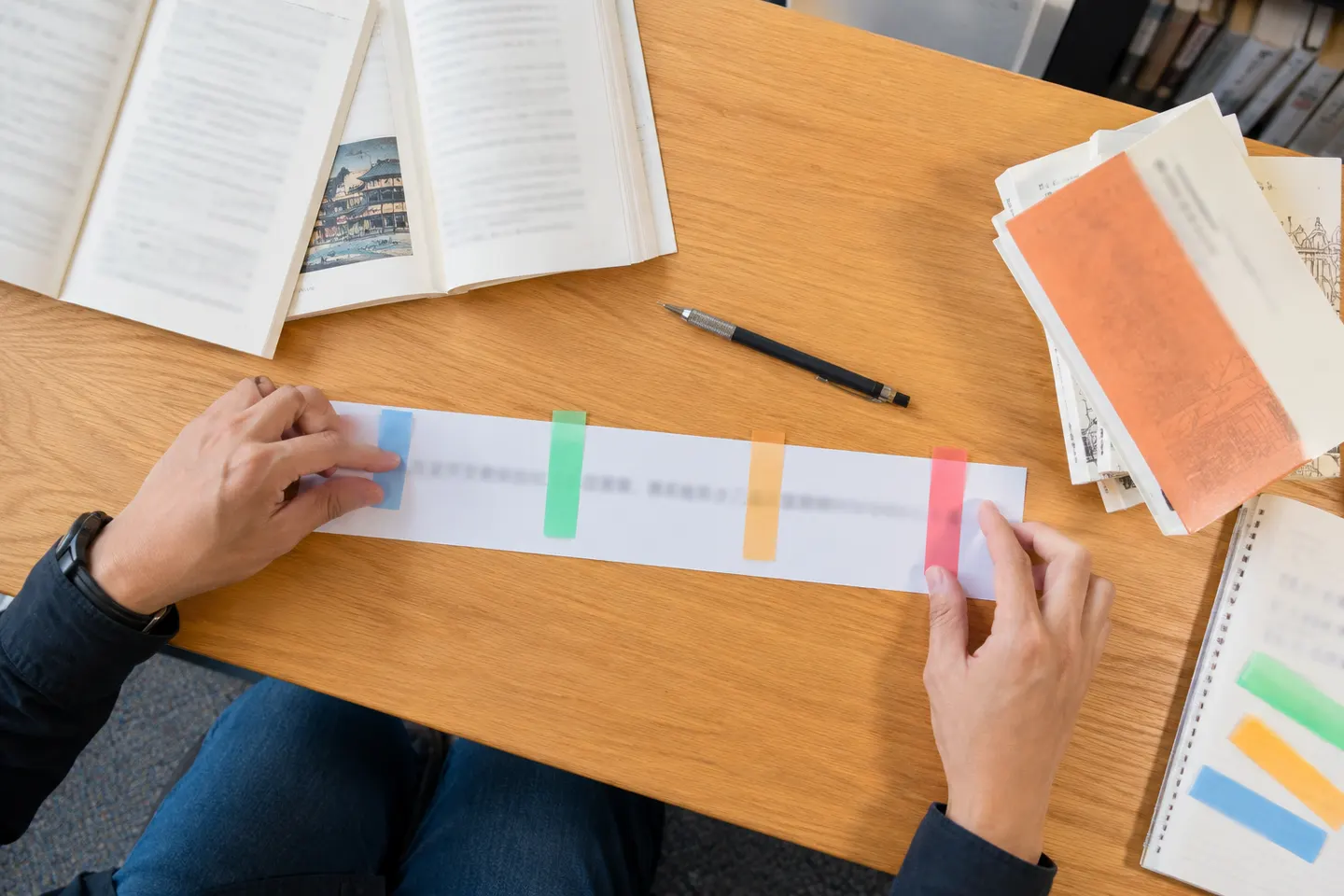
Use a quick annotation that stays inside Japanese structure. Circle the particle and bracket the chunk before it: [雨が] [降っていたので] [駅まで] [バスで] [行きました]. Then ask what each bracket contributes to the final predicate. If a particle remains ambiguous, preserve both reasonable functions until more context resolves it. Forcing a premature translation often creates a confident error; holding a structural question for another few words is a normal reading skill.
Build meaning from chunks instead of isolated words
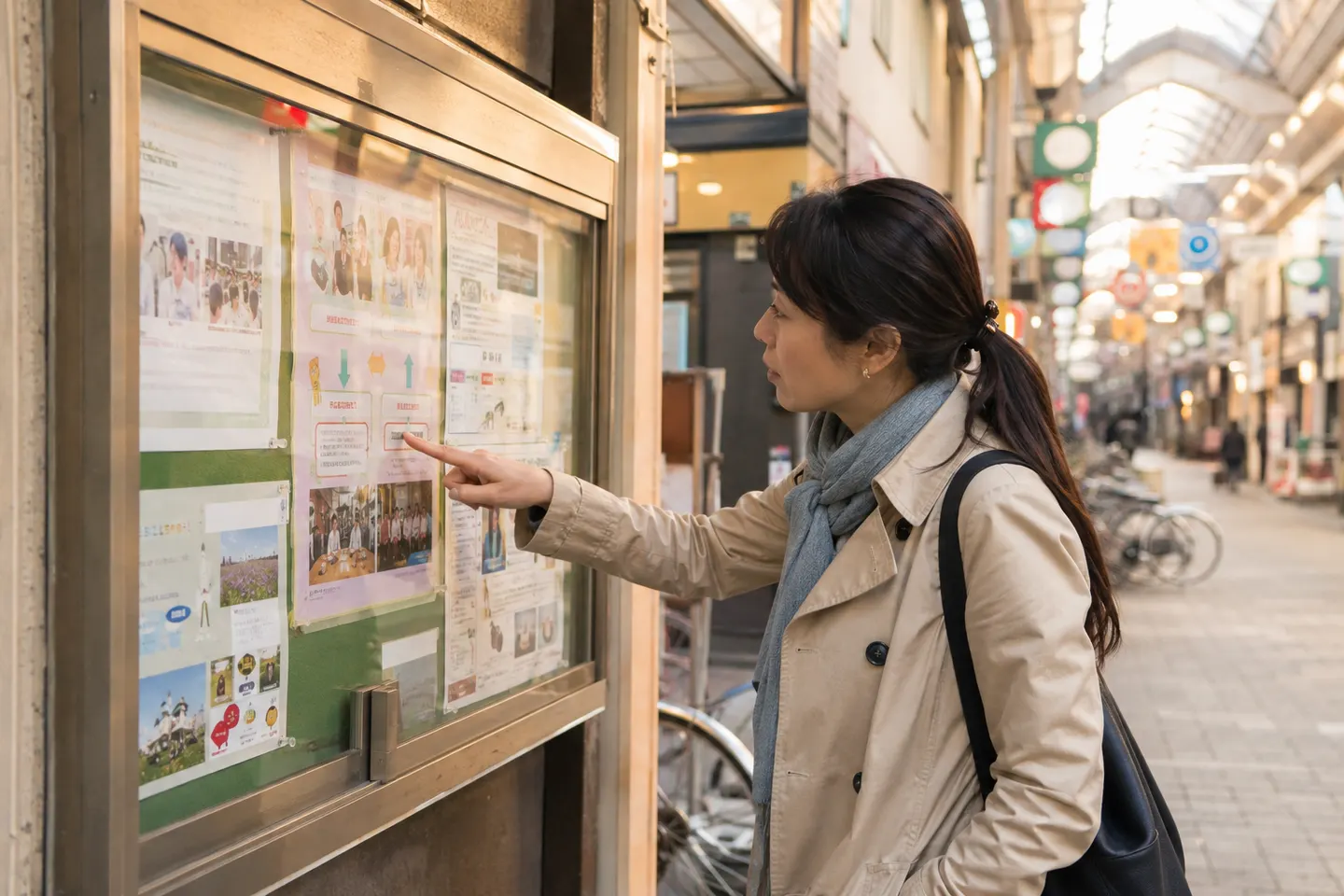
Word-by-word reading breaks phrases that Japanese readers process together. Take 図書館で借りた本をまだ返していません, toshokan de karita hon o mada kaeshite imasen: I have not yet returned the book I borrowed at the library. The chunk 図書館で借りた modifies 本. If you translate in arrival order, you may temporarily attach at the library to the final returning action. Grouping [図書館で借りた] [本を] [まだ] [返していません] keeps the relative clause with its noun and reveals the negative continuing result at the end.
Read each chunk once, but delay the complete interpretation until the predicate arrives. This is especially important with noun modifiers, quotations, reasons and conditions. A longer example such as 田中さんは、忙しくても、毎晩寝る前に日本語の記事を少し読みます becomes manageable as topic, concession, time, object, amount and final action. You are not ignoring individual words. You are giving them a local job inside a larger unit so working memory does not carry ten disconnected translations.
- Locate the final verb, adjective or copula.
- Bracket noun modifiers together with the noun they describe.
- Keep reasons, conditions and quotations as complete chunks.
- Connect each particle phrase to the predicate it supports.
Look up only what blocks the reading task
Unknown words differ in importance. In a story, an adjective describing the color of a bag may be optional while the verb showing that the bag disappeared is decisive. In a schedule, a date or cancellation marker can matter more than every descriptive phrase. Finish a first pass and classify gaps as blocking, useful or safely skippable. Look up the blocking item first. If the main question is already answered, decide whether another lookup will deepen understanding or merely interrupt momentum.
The Japan Foundation's official Irodori guidance follows this logic: check the situation and purpose, understand the outline and key information step by step, use clues before the dictionary, then check useful unknown words and read the text again. It explicitly notes that a learner does not need to understand everything to achieve the reading goal. This is not permission for careless guessing. It is a disciplined order that makes each lookup answer a real comprehension problem.
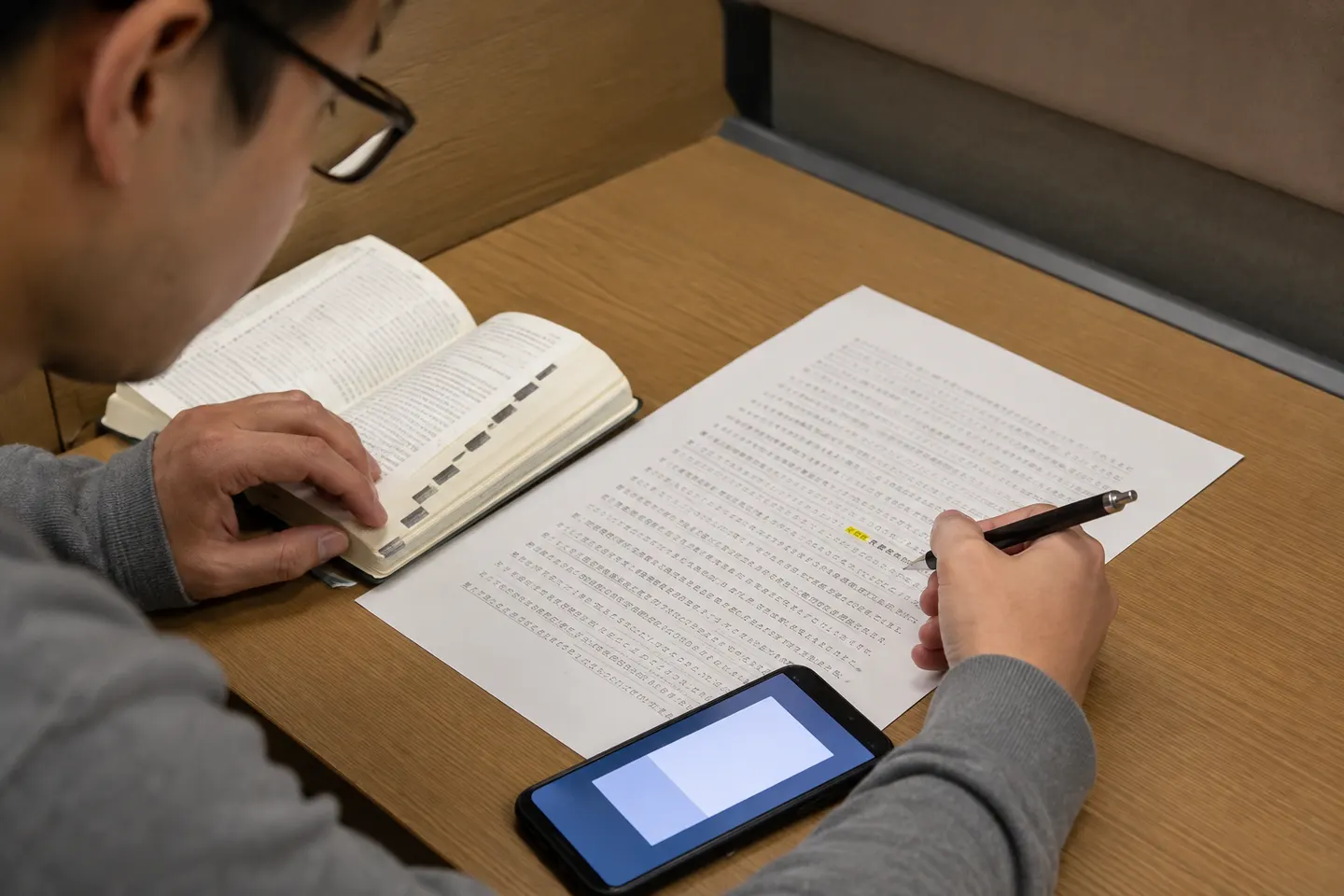
Use the three-pass KanaWay reading workflow
KanaWay is an upcoming app, and its planned reading flow brings graded text, targeted word help, an offline dictionary, saved vocabulary and later review into one path. On pass one, keep support hidden and record the situation, final predicate and best provisional meaning. On pass two, reveal only the reading or definition that repairs a missing connection. Mark whether the obstacle was vocabulary, a kanji reading, a grammar link or the boundary of a chunk. Then close the support and read the original Japanese again.
Pass three turns recognition into retrieval. State the main point without looking at a translation, answer one content question and change a small detail in the sentence if your level allows it. For example, replace バスで with 電車で and read the new relationship, or replace 駅まで with 学校まで. Save only the item that affected comprehension, together with its sentence. Until KanaWay launches, reproduce the same sequence on paper: first interpretation, one selective lookup, full reread and one meaningful recall prompt.
- First pass: situation, predicate, chunks and provisional meaning.
- Repair pass: reveal one reading, word meaning or grammar connection.
- Final pass: hide support, reread the complete Japanese and answer from memory.
- Later review: return to the exact connection that originally failed.
Support should repair your reading, not perform the reading before your Japanese has tried.
Reread for flow, then retell the meaning
A dictionary lookup is not the end of a sentence. Return to its beginning and read the complete line at a natural, comfortable pace. The repaired word should now contribute to one connected idea. If you immediately move to the next sentence, you practise searching more strongly than reading. On the reread, notice whether the final predicate now feels prepared by everything before it and whether the particles lead cleanly from one chunk to the next.
Close the text and give a short retell in the language your level supports. A beginner can name the people, place and action in simple Japanese or a compact meaning sketch. A stronger reader can summarize the cause, contrast or sequence in Japanese. Do not reproduce every word. The goal is evidence that you retained the message rather than the order of dictionary entries. Reopen the text, compare, and correct only a detail that changes the main point.
Follow a seven-day free Japanese reading practice plan
On day one, use five single sentences and identify only their final predicates. Day two adds particle chunks; day three focuses on noun modifiers and embedded clauses. On day four, read a short notice for one practical answer and limit yourself to two lookups. Day five repeats the same text with support hidden. Day six uses a new passage on a familiar topic, and day seven asks you to reread both passages and retell each main point. Ten to twenty focused minutes are enough for this cycle.
Track decisions rather than pages: predicates found correctly, chunks repaired, lookups that were truly necessary and summaries that preserved the main event. If nearly every line requires several searches, choose easier material instead of turning the session into dictionary endurance. If everything is effortless, remove some furigana or choose a slightly denser text. Progress appears when your first pass captures more structure, your second pass needs fewer repairs and the Japanese sentence remains coherent after the translation is gone.
- Days 1–2: predicates and particle relationships.
- Days 3–4: modifiers, chunks and one practical reading goal.
- Days 5–6: reread familiar material, then transfer the method to a new passage.
- Day 7: retell both texts and choose next week's weakest connection.
Understand the message first. Translate only when translation is genuinely the task.