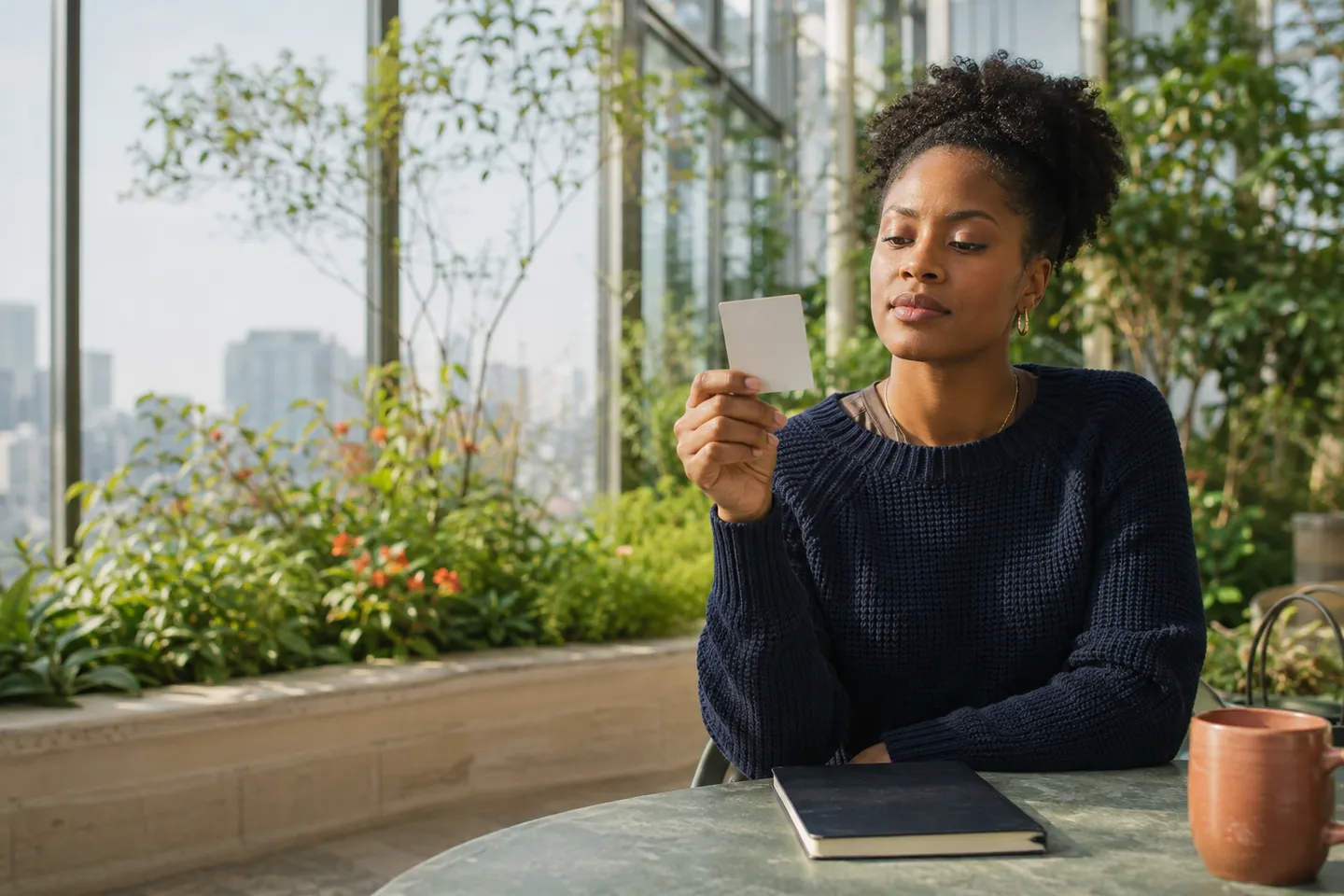
Japanese spaced repetition can schedule the right card on the right day and still leave you unable to answer it. The familiar front appears, you feel that the word is somewhere nearby, and the back looks completely obvious after you turn it over. That feeling is not proof that the scheduler failed. It usually means recognition has been mistaken for recall: the complete answer helped you judge knowledge that the question alone could not yet retrieve.
This free guide repairs that mismatch without demanding a new app or a larger deck. You will define what each Japanese card actually tests, hide every accidental clue, wait long enough to attempt an answer, grade the result honestly and then use the item outside the card. The goal is not perfect recall on every review. It is a review signal you can trust and a memory that still works when the font, sentence, speaker or direction changes.
Japanese spaced repetition starts after the answer disappears
A card shown with its answer is a study event; a card shown without it can become a retrieval event. During study, typography, position, furigana, translation and example sentence all make the target feel available. At test, some of those supports vanish. Koriat and Bjork describe this mismatch as a source of inflated judgments of learning: information present during study can highlight connections that are much less apparent from the cue alone. Testing experience and delayed judgments can make those predictions more realistic.
Reproduce the real condition before you rate a card. Cover the back completely, keep your hands off the reveal control and state the expected answer. If the card asks for a reading, say the full reading. If it asks for a meaning, give a precise meaning that fits the saved sentence. If it asks for production, write or speak Japanese before checking. A vague feeling of knowing is useful as a warning, not as a correct response. Five honest seconds reveal more than five comfortable rereads.
- Recognition: the answer looks right when shown.
- Recall: the answer is produced from the cue.
- Transfer: the knowledge works in a changed sentence or situation.
Name the one answer each Japanese flashcard requires
Many Japanese flashcards quietly ask four questions at once. A front such as 生 can demand a meaning, one of several readings, a vocabulary word, pitch information and handwriting. Failure then gives no useful diagnosis. Replace the bundle with a clear contract. For 学生, one recognition card might ask for the reading がくせい in a sentence; a separate production card might show student and require 学生; a listening card might ask you to identify the word from audio. Each answer can now be right or wrong for a known reason.
Do not split language into meaningless atoms, either. One target does not require one symbol without context. Keep a short sentence when it disambiguates a reading or use, but visually mark what must be retrieved. Remove furigana when the reading is the target. Remove the translation when meaning must come from the Japanese sentence. Keep audio silent until after an orthographic answer if sound would reveal it. A precise card is not necessarily bare; it simply separates the question from the evidence used to judge it.
Separate reading, meaning and production instead of guessing
Japanese creates asymmetric knowledge. You may understand 図書館 while reading but fail to produce としょかん from library. You may hear しゅくだい and know the situation yet not recognize 宿題 on a page. These are not contradictory results; they are different retrieval routes. Decide which routes matter now. Beginners usually need Japanese-to-meaning recognition, reading aloud and a smaller set of meaning-to-Japanese production cards for high-value words. Handwriting can remain a separate task when it supports a real goal.
Grade the requested route only. If the prompt requires としょかん and you answer library, you remembered meaning but missed reading; mark that route as missed. If you produce 先生 for teacher but cannot read it in a sentence, the production success does not erase the reading gap. This may feel strict, but it prevents one strong route from hiding another weak one. Record the error label—reading, meaning, form, listening or production—so the next practice changes the missing connection instead of merely showing the same crowded card sooner.
- 図書館 → としょかん tests reading.
- 図書館 in context → library tests meaning.
- library → 図書館 tests written production.
- Spoken としょかん → the correct situation tests listening.
Build one clear cue without making the answer obvious
A useful cue narrows the task but does not contain the answer. Compare a card showing 行きました with furigana, translation and a highlighted past-time phrase against a prompt that says 昨日、駅に___ and asks for the polite past of 行く. The second card specifies a form and gives a plausible setting, but you still have to retrieve 行きました. If you always see the same sentence, rotate one detail after the form is stable so memory cannot rely on layout alone.
Pictures can help concrete nouns, audio can anchor pronunciation and a short native sentence can distinguish usage. None should become a decorative hint that lets you bypass Japanese. Ask what feature produced the answer: the word itself, the image, the first letter, card position or a memorized silhouette? Remove unintended clues one at a time. For easily confused pairs, use contrast deliberately. A card can ask whether the action occurs at 学校で or moves toward 学校に, but it should still demand one explicit choice and explanation.
Attempt, reveal, correct and retrieve again
Use the same four-step loop for every difficult card. First attempt an answer without peeking. Then reveal and compare the exact parts: reading, long vowel, kanji, particle or verb form. Correct the smallest failed element and say why it changed. Finally hide the answer and retrieve it once more from the original cue. The second retrieval matters because merely reading the correction can recreate the same familiarity that caused the problem. Stop after one successful repair and let spacing provide the next challenge.
Retrieval practice is not valuable because quizzes feel severe. It gives memory practice at finding information from a cue and produces feedback about what is actually accessible. Research on test-enhanced learning generally finds benefits over restudying, but a card session should not consume the whole language. Ten precise misses are more informative than one hundred rapid flips. If a word fails three times in one sitting, change the representation or return to the source sentence; repeated failure against the same cue rehearses frustration more than use.

Grade Japanese flashcards with evidence, not effort
Decide grading rules before the session. Correct means the requested answer arrived before reveal and was accurate enough for the task. A long hesitation can be recorded as hard even when correct. Almost is a miss when the missing part changes the word, such as おばさん versus おばあさん, or when the wrong particle changes the event. A minor accent uncertainty need not fail a beginner meaning card unless pronunciation was the target. Consistent rules make intervals informative; generous mood-based ratings do not.
Do not punish every typo equally. If you type きょう and the card required 今日, decide whether the task was reading, kana production or kanji production. Mark according to that contract. Likewise, recalling one English synonym may be enough for recognition when the Japanese range is broader, but a saved sentence should keep the meaning honest. Add a short note only when it prevents the same ambiguity next time. Long explanations on the answer side often make review slower without improving the cue.
- Correct: retrieved before reveal and met the stated target.
- Hard: correct but slow, unstable or dependent on reconstruction.
- Miss: answer absent, wrong, or supplied by an unintended clue.
- Edit: the prompt allowed several reasonable answers or tested too much.
Use intervals to expose memory, not to protect a streak
Spacing works because the next attempt happens after some forgetting, not because an algorithm can certify mastery. When a card returns, reproduce the same honest test. If it fails, shorten its path and inspect the cause. Was the word never understood, was the cue ambiguous, did two similar items interfere, or did the card ask for an unused production route? Fix cause before multiplying repetitions. A small manual Leitner box can follow the same principle: misses return soon, secure cards move to less frequent compartments.
Backlogs require triage. Pause new cards, keep a manageable daily cap and rescue high-value items first. Suspend duplicates, facts outside your current goals and cards that cannot be answered consistently. Do not clear a backlog by pressing correct while rereading the back. That produces a clean queue and unreliable memory. A shorter deck with trustworthy ratings supports reading and listening better than a huge deck maintained for its own sake. Spaced repetition decides when to ask; you still decide whether the question deserves space.
Follow a seven-day free Japanese flashcard reset
On day one, choose twenty troublesome cards and write the required answer on each prompt. Day two removes furigana, translations and visual hints that reveal those answers. Day three separates reading, meaning, listening and production where one card mixes them. Day four runs the attempt–reveal–correct–retrieve loop and labels every miss. Day five places ten repaired items into new sentences. Day six tests half through audio or conversation. Day seven reviews only due cards, then retires any prompt that remains ambiguous.
Keep the experiment small enough to observe. Count answers retrieved before reveal, cards edited because the cue was unfair and items understood in a changed sentence. Do not use review count as the main result. A successful reset may reduce the deck while increasing honest misses at first. That is improvement: the cards are finally measuring the skill you need. KanaWay is still upcoming, and its planned review flow is designed to return to weak connections across lessons and practice. The complete paper method here works independently today.
Hide the answer, name the target, retrieve once, repair the exact miss and use the word beyond the card.