
Japanese dictation is useful when a sentence looks familiar on the page but disappears in sound. The difficulty may be a word you did not recognize, a short ending you missed, or simply too much speech to hold while typing. Writing your first attempt makes that uncertainty visible. The aim is to locate one repairable gap and then understand the message again, rather than collect a perfect transcript by copying the answer.
This guide uses a short recording, its matching script and a place to save your first attempt. It also shows how the listening and dictation workflow described for KanaWay can connect that attempt to later review. KanaWay is an upcoming app; this is a practical account of the learning sequence, not a report of released features or measured results. You can follow the same sequence today with suitable audio, paper and a covered script.
Japanese dictation starts with a manageable clip
Choose one short utterance from material whose written language you largely understand. A familiar situation, such as ordering a drink or arranging a meeting, gives the sound a purpose. Use a recording with an accurate matching script. A summary or a translated subtitle is not enough for checking exactly what was spoken. Confirm that the script belongs to the selected recording and note where your chosen utterance begins and ends.
Try the clip once before committing to it. If you cannot identify the situation or recognize anything useful, shorten the selection or choose easier material. Dictation cannot separate listening difficulties from missing vocabulary when nearly every expression is unknown. If you understand the whole line immediately, keep it as a warm-up and select a slightly more demanding utterance. Difficulty should leave a specific question to investigate.
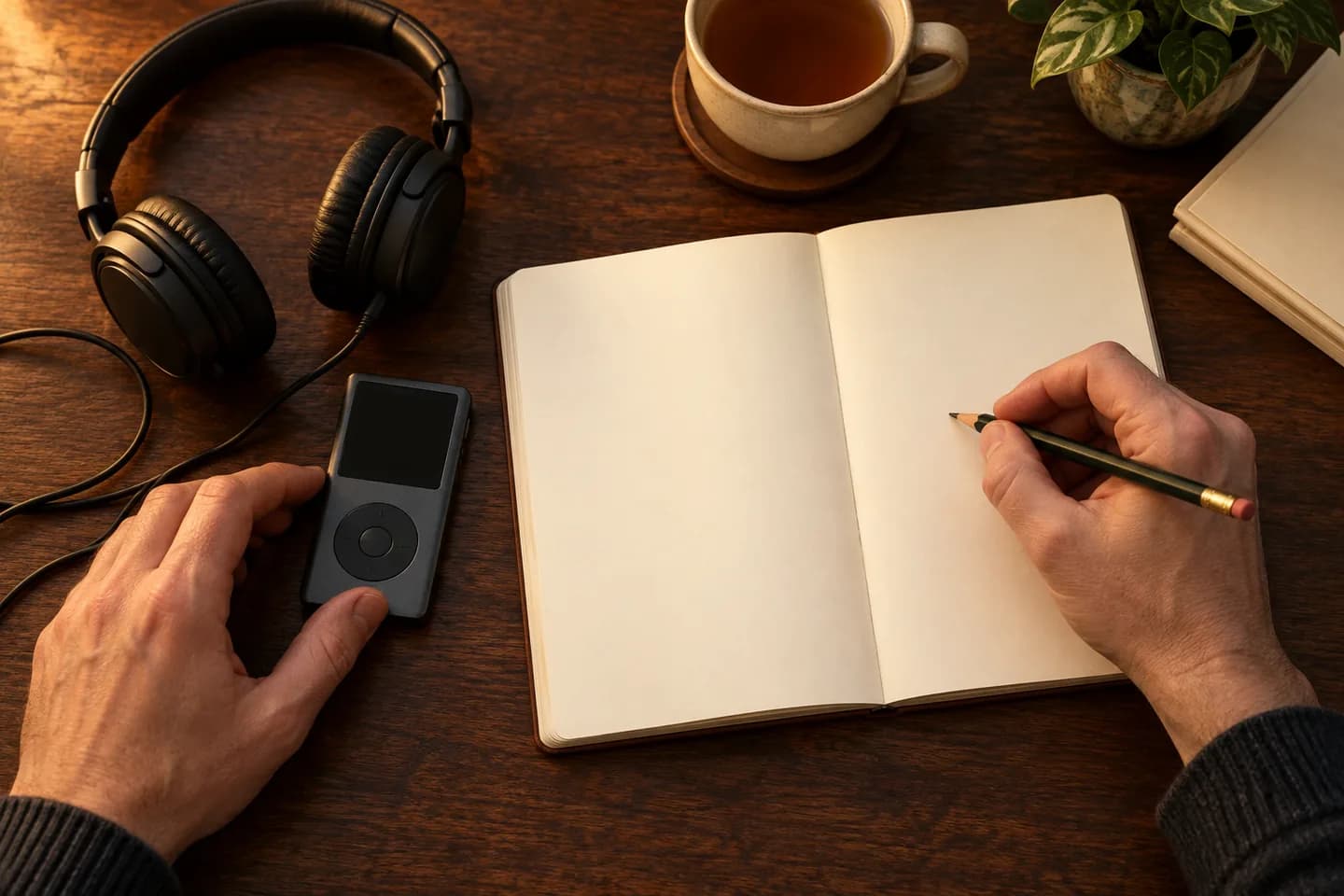
Use a quiet place and a comfortable volume. Headphones may help you separate the recording from surrounding noise, but louder audio is not a solution for unfamiliar language. Keep the script covered, including any preview that reveals the answer. Prepare three spaces for your first attempt, the checked version and a short diagnosis. Keeping them separate preserves the evidence that the correction would otherwise erase.

Listen for the situation before writing
On the first complete play, ask what the speaker is doing. Are they making a request, giving information or changing a plan? Write a brief answer in your own language if necessary. This is a meaning check, not yet a spelling task. A line about a meeting is useful because someone needs to act on it; hearing several recognizable words without knowing the proposed action leaves the central problem unresolved.
The Japan Foundation's Irodori guide describes listening to a dialogue for its broad content before following the script for detail. That sequence offers a useful distinction for this exercise: first establish the message you think you heard, then inspect the language supporting it. It does not mean every passage has to be mastered after one play. Your uncertainty is part of the information you are collecting.
Record one missing detail as a question. For example, did the speaker name a location or a time? Did they keep the original plan or replace it? Choose the question from the actual situation rather than from a fixed list. On the next play, listen for the evidence answering it. Do not reveal the script just to remove the discomfort of an unfinished answer; give the sound a specific job first.
Save a first attempt with honest gaps
Now write or type what you hear. If handwriting distracts you, type; if choosing kanji interrupts your listening, use kana for this attempt. The task is to capture the language you believe was spoken. You can work on conventional spelling separately after checking. A slow input method should not turn the exercise into a test of how quickly you can operate a keyboard.
Leave a visible blank where something is uncertain. You can mark a possible hearing with a question mark, but do not silently fill the gap from what a textbook sentence would normally say. Keep the original attempt when you correct it later. Otherwise, a polished page may suggest that you heard language which you actually obtained from the script. The uncertainty mark distinguishes evidence from a plausible guess.
If you lose the end while recording the beginning, reduce the listening unit to a complete short phrase. Avoid slicing it into isolated sound fragments before you understand its place in the sentence. Replay the phrase, capture it, then return to the whole utterance. Write down whether the problem was remembering the line or identifying its sounds. Those difficulties call for different adjustments, even when both leave an empty space.
Give each replay one precise question
Read your first attempt without looking at the answer and choose one gap. Replay the full utterance with that gap in mind. If the phrase still passes too quickly to inspect, replay the shorter meaningful unit containing it. Keep enough surrounding sound to understand where it belongs. An isolated ending may be easier to hear but harder to interpret when you have removed everything it connects to.
Set a practical stopping point, such as two focused replays after the first attempt. This is an editorial suggestion for keeping the session useful, not a scientifically fixed limit. More plays are reasonable when each one changes your understanding. Stop when you are restarting the same audio with the same unanswered question and no new evidence. The next step is comparison, not another identical attempt.
Record any change before revealing the script. Perhaps you now hear a missing word but remain uncertain about its ending. Perhaps the sound is clearer but its meaning is unknown. Keep those distinctions. A vocabulary problem needs an explanation and context; a sound-recognition problem needs another encounter with language you understand. Counting all uncertainty as bad listening hides the useful next action.
Compare the script without erasing your evidence
Reveal the matching script and place it beside your first attempt. Check one phrase at a time. Mark what was absent, substituted or uncertain, and distinguish a sound gap from a spelling difference. Kana that correctly represents the spoken word can show successful hearing even if the script uses kanji. Conversely, selecting the correct-looking kanji after seeing the answer does not establish that you recognized the word in audio.
Choose one correction that changes your understanding of the message. A missed word can alter the requested item; an ending can change whether something happened or is being proposed. Avoid collecting every unfamiliar detail from a passage that was too difficult in the first place. If several basic expressions need explanation, return to the relevant lesson and select a shorter clip for the next dictation session.
Read the repaired phrase and confirm what it contributes. Then follow the script for one play, cover it and listen to the whole line again. The final covered play matters: it asks whether the written explanation has connected back to sound. If you can only follow while reading, the comparison was useful preparation, but the listening problem is not yet resolved. Keep that distinction in your notes without treating it as a failure.

Connect the attempt to a KanaWay lesson
KanaWay's described listening workflow combines listening before reading, replay with a purpose, typing what you hear and comparing segments. In the upcoming app, use a short task connected to language from your course rather than beginning with an unrelated advanced passage. Give the audio a first attempt, examine the comparison and identify the one phrase that prevented you from following the situation. Keep the aim narrower than achieving a flawless score.
If the comparison points to an unfamiliar word, return to its meaning and example in the course. If the words are familiar but you missed their connection, listen to the complete phrase again. Follow with a related reading or listening task that uses the language in context. This is the useful connection between explanation, attempt, feedback and review; repeatedly entering a visible answer would skip the attempt that makes the feedback informative.
Keep a brief paper note if you want to record a personal diagnosis; do not assume the app has a custom error journal or accepts arbitrary recording uploads. KanaWay describes device-based Japanese pronunciation, so that audio should not be treated as proof that you will understand every spontaneous speaker. Include suitable recorded dialogues in your wider routine. The app workflow can organize practice without replacing exposure to different voices and real conversational conditions.
Check an error category instead of a perfect score
After comparison, give the main gap a useful label: unfamiliar language, known word missed in sound, short form overlooked, or too much to retain. These are practical categories for choosing the next task, not a diagnosis of your general ability. One passage may contain several problems. Select the one that most affected understanding and explain it in a short sentence, such as I recognized the words on paper but missed the final phrase.
Change the next session to match that observation. For unfamiliar language, learn a small amount through its example before using audio again. For retention difficulty, keep the language level stable and shorten the utterance. For a known phrase missed in sound, revisit its audio after the text is covered. Do not increase length and introduce many new words at the same time, because you would lose the comparison with the original difficulty.
Separate your first covered attempt from the corrected version when judging progress. A later perfect copy has a different meaning from a more accurate independent attempt. You can count the uncertainties if that helps, but keep a message question alongside the count. Fewer spelling errors are useful only within the goal of understanding what the speaker means. Dictation is one tool for that goal, rather than the whole listening skill.
Return later and test a changed message
End the session by listening with the script closed and explaining the message in your own words. Revisit the phrase on another day before opening the corrected version. A quick immediate replay may partly depend on remembering the written answer you just saw. A later attempt gives you a clearer view of what you can recover from the sound. There is no promised number of days after which every phrase becomes secure.
Then try a different short utterance with familiar language and a similar purpose. Change the message rather than only playing the memorized line again. If the new recording changes a meeting location, for example, identify the new location instead of supplying the one from yesterday. Keep the same covered-script sequence so the comparison is fair. When the changed line is too demanding, return to a shorter unit without abandoning the meaning question.
Your session can finish with a small record: the clip used, your first attempt, one corrected gap and the later check you intend to make. That is enough to guide the next action. Stop before correcting a line becomes copying an entire script. The useful outcome is a clearer connection between one piece of Japanese you know and the sound carrying it, followed by a fresh chance to understand it without written support.