Japanese particles に and で can both appear after a place, but they do not offer two interchangeable translations of English “at” or “in.” Use に when the place is the point where someone or something exists, the destination of movement, or the endpoint of a change in position. Use で when the place is the setting in which an action or event happens. The verb and the event decide the particle; the English preposition does not.
That distinction explains the core pair: 学校にいます means “I am at school,” while 学校で勉強します means “I study at school.” The building is identical. In the first sentence it locates a person’s presence; in the second it provides the stage for studying. This guide turns that contrast into a decision process, covers patterns that resist an oversimplified action rule, and shows how to practise a particle beyond one memorized sentence.
Choose Japanese particles に and で from the event
Begin with the predicate, not the place word. Ask what the sentence says about that place. With います and あります, it identifies where a person, animal or thing is located: 公園に子どもがいます, “There are children in the park,” and 机の上に本があります, “There is a book on the desk.” With an activity such as studying, eating, talking or playing, で marks where the activity unfolds: 公園で遊びます, “I play in the park.” The noun 公園 has not changed meaning; its role in the event has.
The Japan Foundation’s Irodori grammar notes explicitly contrast に for a place of existence with で for a place of an action or act. This is a more durable starting point than translating a list of prepositions. Yet it is still a starting point, because Japanese particles have several related functions and verbs select particular patterns. Learn the central contrast first, then attach each additional use to a complete sentence. A particle remembered together with its verb and meaning is easier to reuse than a particle remembered as a one-word English equivalent.
Contrast existence with activity in the same place
Minimal pairs make the difference visible. 図書館にいます says that someone is in the library. 図書館で本を読みます says that reading happens there. 部屋にテレビがあります places a television in the room; 部屋でテレビを見ます places the act of watching there. Do not ask which particle belongs to 図書館 or 部屋. Ask whether the sentence locates an entity or locates an activity. This question handles many beginner choices without hiding the verb behind an English translation.
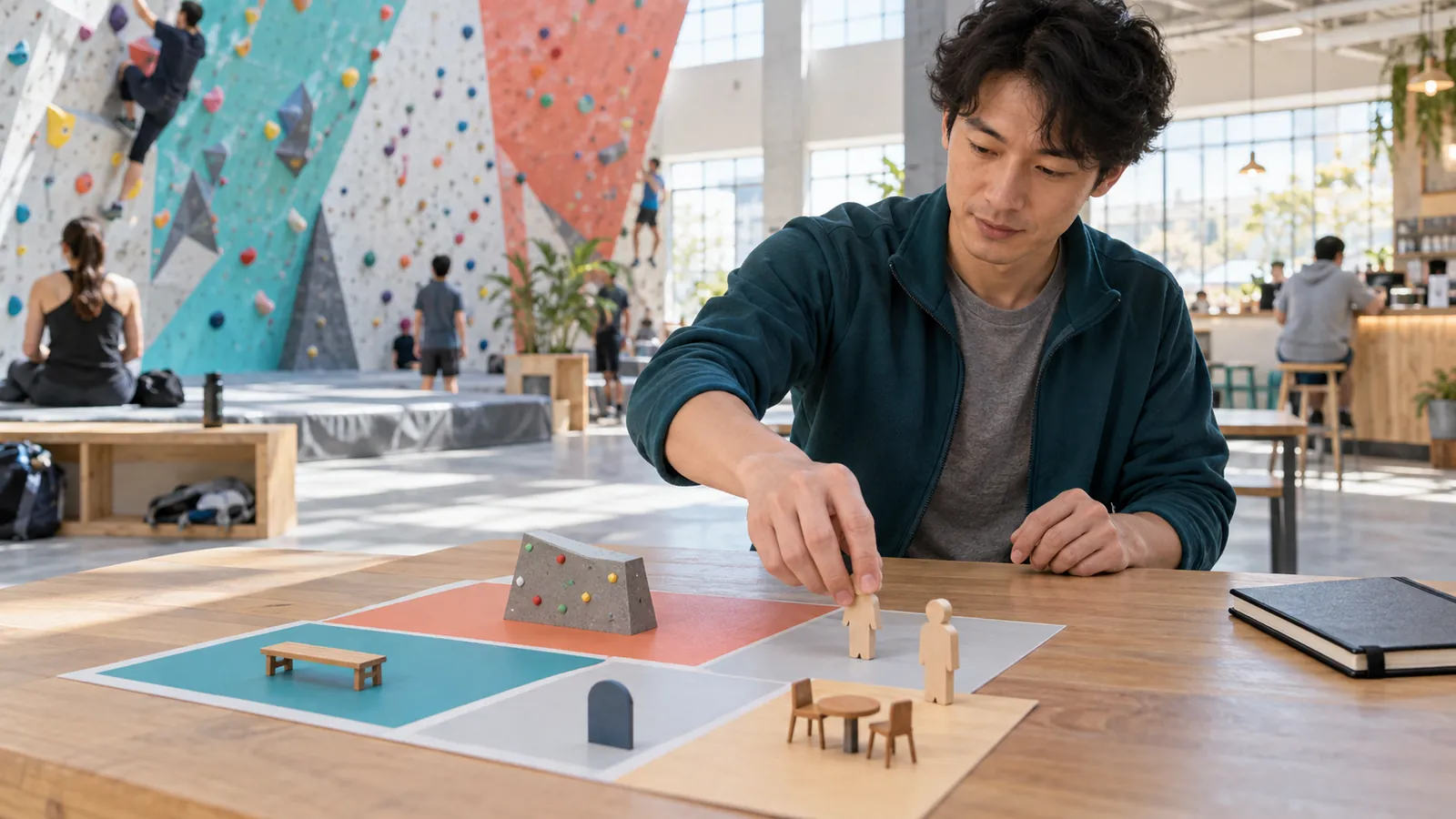
Build the contrast in both directions. Given a place, create one existence sentence and one activity sentence. Given a verb, choose a plausible place and explain its role aloud: います needs a location of presence, while 食べます can take a place where eating occurs. Then remove the English. Pictures, gestures or a simple room plan can supply the situation while Japanese supplies the relationship. If you can only answer after thinking “in equals one particular particle,” the memory is still attached to translation rather than to the event.

Use に for a destination and で for what happens there
Movement adds a second useful contrast. 図書館に行きます marks the library as the destination of going. 図書館で勉強します marks it as the place where studying occurs. A natural sequence can contain both roles across two clauses: 図書館に行って、そこで勉強します, “I go to the library and study there.” The first place is an endpoint of movement; the second is the setting of the next activity. Looking only at whether the sentence contains motion will not solve every case, so keep the main verb of each clause in view.
Practise with a short route rather than isolated substitutions. Choose three places: a station, a market and a café. Say where you go, then what you do after arriving: 市場に行きます。市場で野菜を買います. Change only the action and keep the destination stable. Next reverse the exercise: keep 買います and change the place where buying occurs. This separates two decisions that English may compress into one phrase. It also prevents a common error in which a learner uses に for every place connected with physical movement, even when the marked place hosts the activity.

Do not reduce the choice to movement versus no movement
The shortcut “movement takes に, action takes で” breaks as soon as you meet verbs such as 座ります or 住んでいます. いすに座ります marks the chair as the resulting position or point where the person settles. 東京に住んでいます uses に with the place of residence. Sitting and living involve human behavior, but Japanese presents the marked place differently from the stage of an activity such as 椅子のそばで話します, “I talk beside the chair,” or 東京で働いています, “I work in Tokyo.” Learn these patterns with their verbs rather than forcing them through a binary physical-motion test.
A better check has three steps. First identify the predicate. Second ask whether the place is an existence point, destination or resulting position, or the arena of an activity. Third compare the sentence with a familiar model using the same verb. This allows general understanding and lexical learning to cooperate. The rule predicts why 学校で勉強します works; the stored pattern 東京に住んでいます protects you where the label “action” is too vague. Good grammar knowledge is not a slogan that replaces examples. It is a compact model refined by recurring, trustworthy sentences.
Keep other uses of に and で separate from place
Both particles do more than mark locations. に can mark a specific time in 7時に起きます, a recipient in 先生にメールを送ります, or a person encountered with 友達に会います. で can mark a means in バスで学校に行きます, a material in 木で作ります, or a cause in 病気で休みました. These uses are related within Japanese grammar, but piling them into the place lesson too early makes every choice feel arbitrary. Label the role of each marked phrase rather than translating the particle alone.
Notice how one sentence can contain both without competition: バスで学校に行きます uses で for the means of travel and に for the destination. 午前9時に学校の前で会いましょう uses に for a specified time and で for the setting of the meeting. The particles answer different questions, so they do not replace one another. During review, underline the noun phrase together with its particle and connect it to the predicate. A bare list—に equals at, to, on; で equals at, by, with—loses the structure that makes the sentence understandable.
Diagnose the mistake by rebuilding the sentence
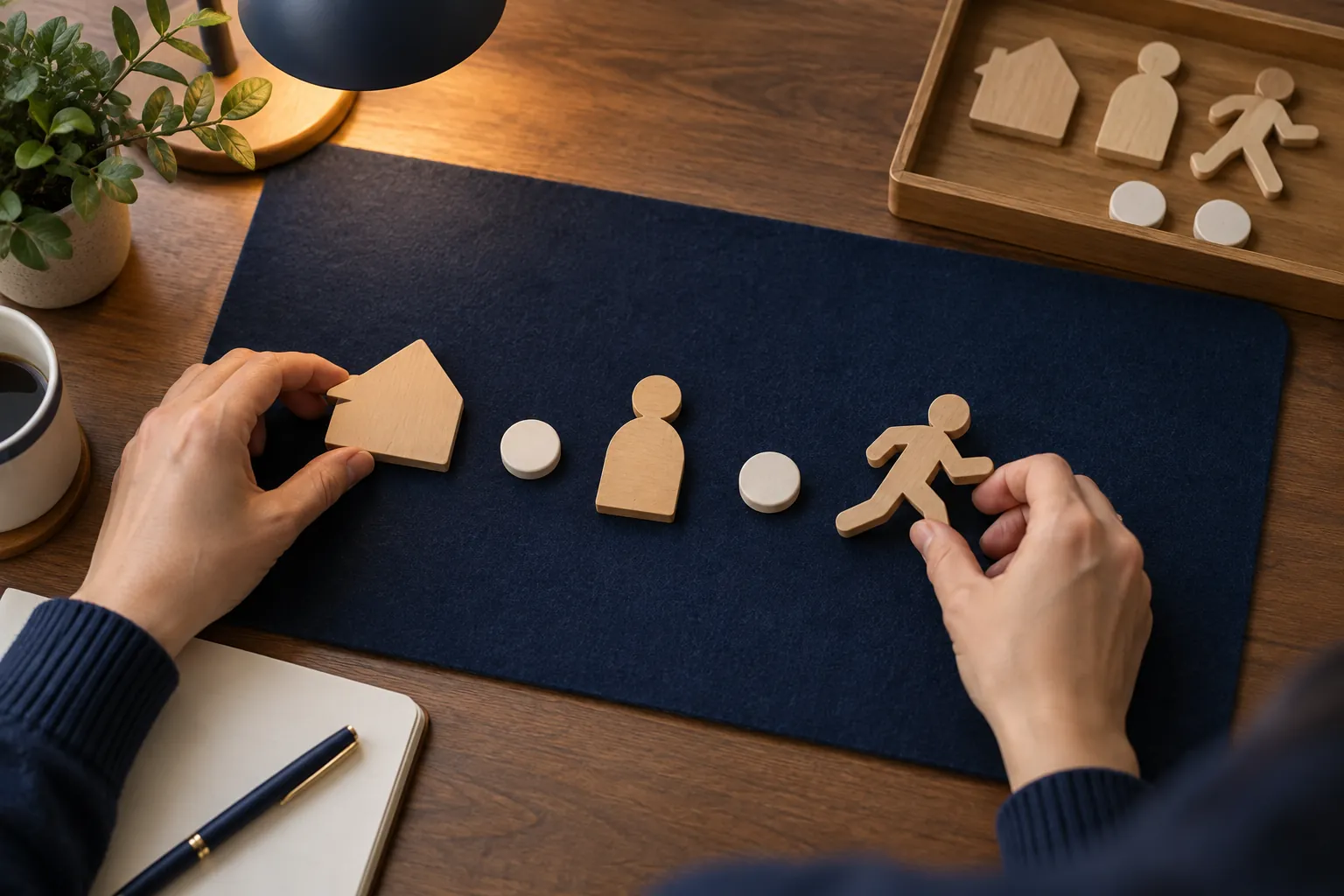
When you choose the wrong particle, do not copy the corrected sentence five times without analysis. Keep the place and change the predicate to create a true contrast. If 学校に勉強します was corrected to 学校で勉強します, add 学校にいます and 学校に行きます. Now you have an activity, existence and destination using one familiar noun. Say what each version means before looking at the particle. This turns a red mark into a small system and reveals whether the problem was the verb, the event role or an unreliable translation cue.
Also test whether changing only the particle produces a natural sentence with a different interpretation, an unnatural sentence, or a sentence requiring a different context. Not every pair is a neat minimal contrast. Grammar practice should not teach that particles can always be swapped mechanically. Ask for a complete situation: who is present, what changes, and what is the main predicate? If the prompt is ambiguous, improve the prompt instead of memorizing one unexplained answer. Accurate correction includes the reason the alternative fails in that particular sentence.
Use a KanaWay attempt-and-transfer loop
KanaWay is still upcoming, but its planned grammar workflow can be described concretely. Begin with a short contrast such as 図書館にいます and 図書館で勉強します. Next see a new place and choose a particle before the explanation appears. After feedback, rebuild the missed sentence by selecting the place, event and verb in order. The important step comes later: the same relationship returns in reading or listening with a different noun. The app supports the sequence; it does not make the grammatical decision for you.
Keep the attempt small enough to explain. On a miss, name the role: existence, destination, resulting position, activity setting, time, recipient or means. Then produce one fresh sentence that uses the same role. A correct tap without an explanation may show recognition; a new sentence shows stronger transfer. KanaWay’s value here is continuity between explanation, attempt, feedback and later review. You can use the identical method now with paper cards: front side shows a simple situation, back side gives one natural model and a brief reason.
Test に and で in a genuinely new situation
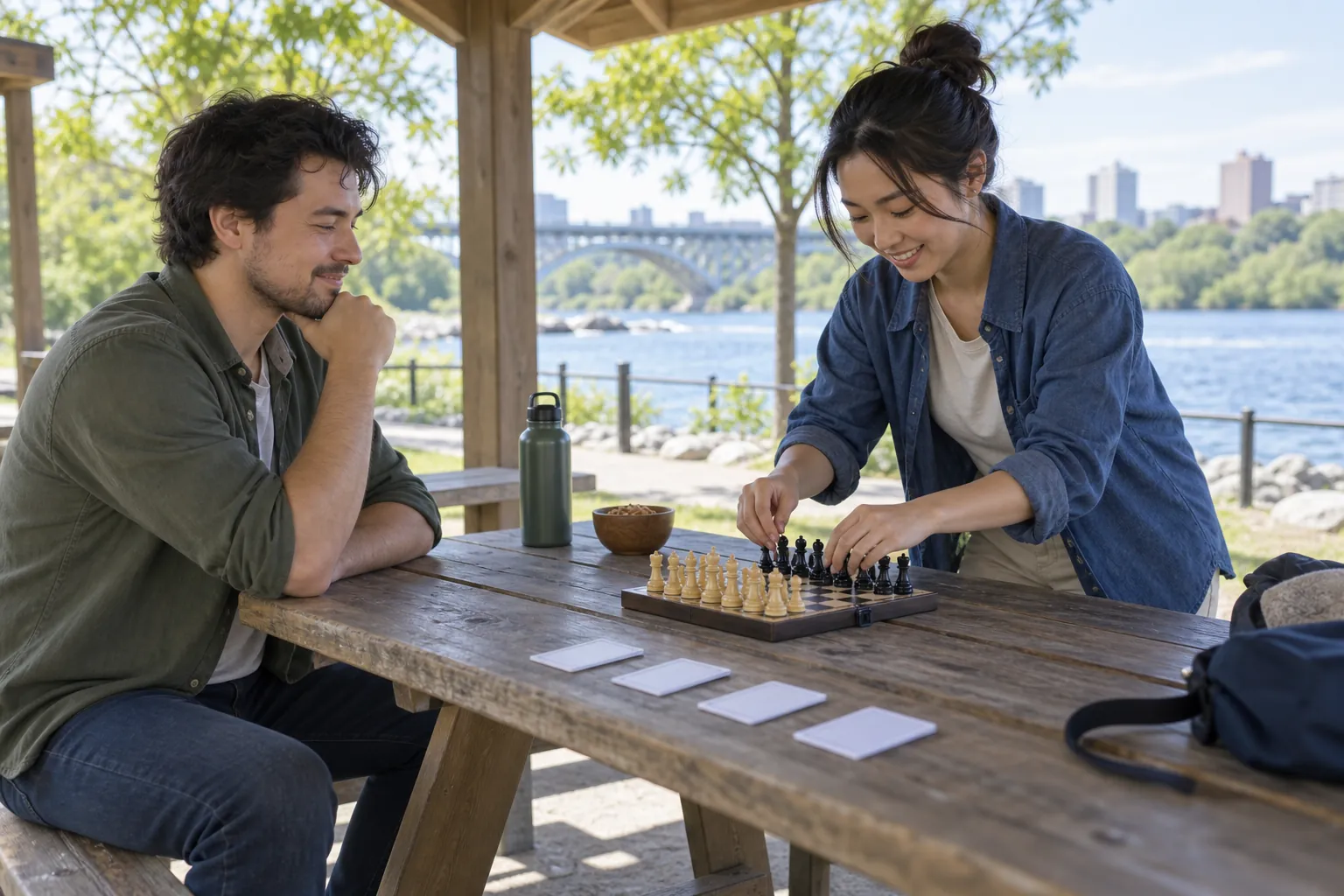
Finish with a scene you have not memorized. Imagine two friends at a riverside shelter. One is sitting on a bench; the other is playing chess at a table. You might say ベンチに座っています for the settled position and テーブルでチェスをしています for the activity setting. Now change one fact: both friends go to the shelter. The destination becomes あずまやに行きます. Change another: they travel by bicycle. 自転車で行きます uses で as means, not as a place marker. One coherent scene can therefore exercise several distinct roles without a random worksheet.
The goal is not to recite “に means point and で means action” faster. It is to inspect a Japanese event accurately enough that the particle becomes a consequence of meaning. When uncertain, return to the predicate, name the role of the marked phrase, and compare it with a trusted sentence using that verb. Save recurring verb-particle patterns and revisit them in different contexts. Once you can explain why the same place takes に in one sentence and で in another, you have moved beyond translation and gained a choice you can carry into conversation, reading and writing.