
Japanese past tense is easy to recognise in a chart and surprisingly easy to lose when someone asks about yesterday. You remember an action, choose a familiar verb and finish with the ending you use for a routine. Or you remember that the event did not happen but leave that fact out of the sentence. The immediate problem is choosing time and affirmation together before producing the verb.
This guide focuses on short polite verb sentences with ました and ませんでした. It does not attempt every Japanese past construction. KanaWay is an upcoming app; its described grammar explanations, practice feedback, dictionary, saved-word review and listening or reading areas can support the sequence here. Personal prompts remain on paper. Start from a checked model, answer once without looking, diagnose one error and revisit the choice in another situation. The goal is a truthful short report, rather than reciting a row of endings.
Japanese past tense starts with the event you mean
Before changing a verb, decide what you are reporting. Choose a familiar action in a finished period, such as yesterday, and decide whether it happened. A learner can form a beautiful affirmative sentence that contradicts the situation on the prompt. That is a meaning error even if every character is well written. Put two separate notes on paper: the time you mean and whether the action occurred. Keep the language task small enough to check both.
Tokyo University of Foreign Studies explains the polite past verb patterns and their formation. Use that reference to confirm the ending, then work from your own simple event cue. In KanaWay's described grammar area, read the relevant explanation and available example before attempting the corresponding practice. Do not assume that reading an explanation creates an answer you can retrieve. Close the model and ask what information the listener should learn from your response.
For the first round, avoid a complicated holiday story. One event with a clear answer is enough. If you use a fictional card, label it as fictional so you do not confuse accurate Japanese with a claim about your real day. If you use a real memory, choose an ordinary detail you are comfortable sharing. Neither the exercise nor the app needs a private diary of your activities.
Keep the checked stem and change the polite ending
From a known polite form, replace ます with ました for the affirmative target here. 勉強します becomes 勉強しました, read べんきょうしました, meaning studied in this context. Do not add an ending to the whole original form. Write the starting form and target on different cards so you can see which part changes. This is a focused transformation from a verified form, not a shortcut for guessing an unfamiliar verb's stem.
Select only a few actions you already understand. Cover the target, recover it and then compare character by character. Say the intended meaning before checking the answer. If you produced the correct ending with the wrong action, return to vocabulary. If the action is right but the ending is wrong, keep the same word and practise that change. Increasing the list before identifying the failure makes your next attempt harder to interpret.
Use KanaWay's available practice feedback for its own activity. For an extra sentence written on paper, compare with a reliable model or ask a qualified reader about a specific uncertainty. Do not assume that the app automatically evaluates arbitrary diary entries. A useful correction names the gap: base form, ending or intended meaning. Keep that diagnosis beside the original attempt instead of erasing the evidence immediately.
Give a past negative its complete ending
The negative target is ませんでした. Build it from a checked ません form by adding でした. 勉強しませんでした, read べんきょうしませんでした, means did not study in the situation used here. Keep the negative element when you speak or write. A response that reports studying after a card said it did not happen reverses the message; it is more than a minor slip at the end.
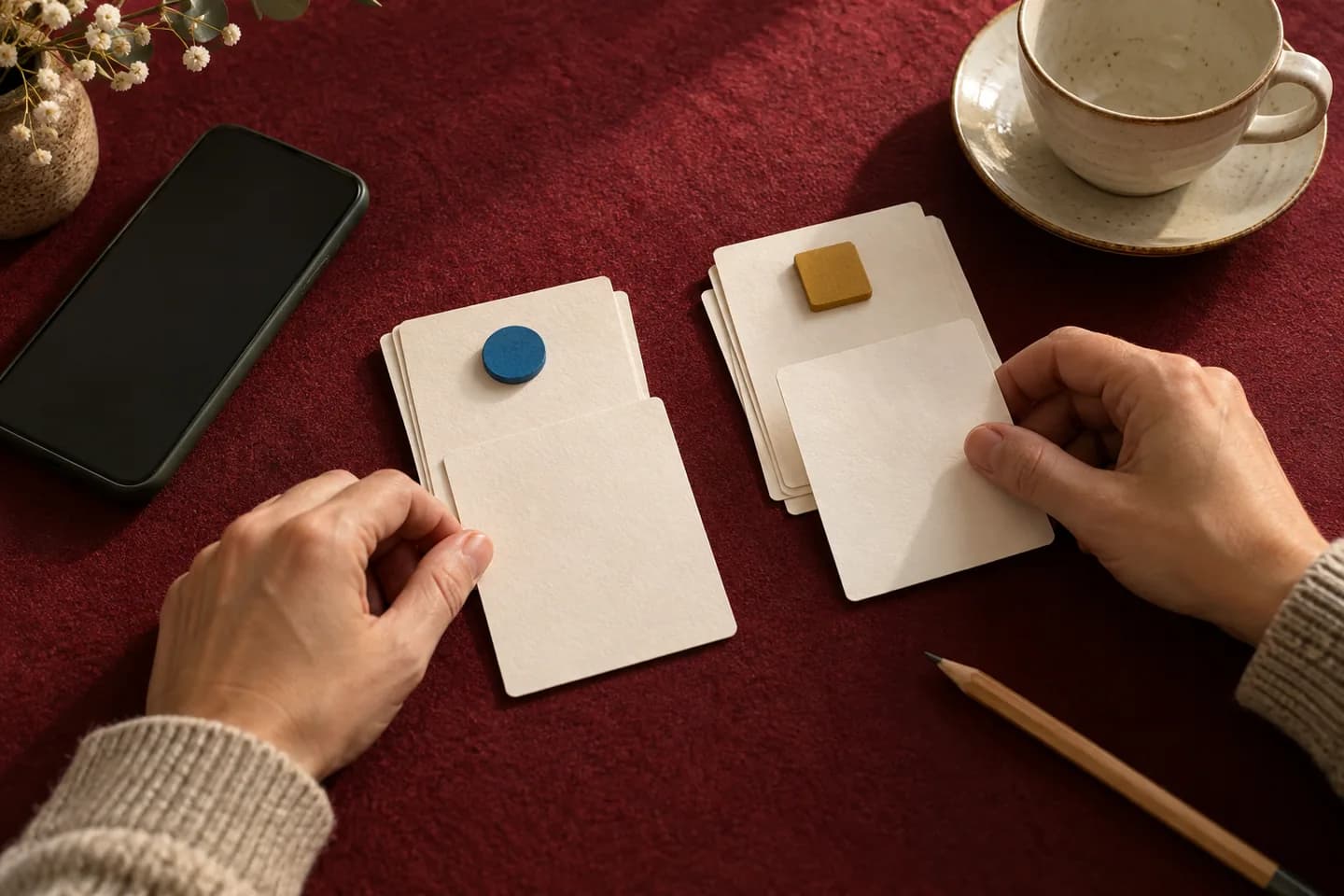
Practise affirmation and negation from mixed cues rather than two predictable blocks. Make a paper card for an action that happened and another for an action that did not happen, then change their order. The learner must read the cue before choosing an answer. If every second card always requires the negative, the sequence itself can supply the response. Vary the order and check the meaning after each attempt.
Give the longer ending enough attention without inventing a pronunciation rule from its spelling. When audio is available, listen to the complete model and compare your attempt to it. Keep a written meaning check separate from a listening check. You may know what a negative sentence says while missing part of its ending in connected speech. Those are different observations and deserve different next steps.
Anchor a short report without building a whole diary
A compact model is きのう、勉強しました, read きのう、べんきょうしました: I studied yesterday in a context where the speaker is reporting their activity. The time word きのう means yesterday. Keep that reference point clear when practising later. A card saved on Monday that says yesterday does not still refer to the same day on Friday. Label your paper situation with a date when that distinction matters.
The Japan Foundation's Irodori starter lesson 17 places past reporting in exchanges about days off. Use its context and available audio as a checked learning example. Your own practice can be much smaller: one time cue, one known action and a decision about whether it happened. Do not copy an entire dialogue and replace several details simultaneously. Change one feature so that you can explain what the new response communicates.
If the verb itself is uncertain, use KanaWay's described dictionary route to check its meaning and known form. Save a useful word for later review when that option is relevant. Keep your event record on paper. A dictionary entry can support the action word; it does not establish that your whole original sentence is grammatical or that the event really took place.
Answer the question instead of echoing its positive shape
Try きのう、勉強しましたか, read きのう、べんきょうしましたか: did you study yesterday? The question supplies a possible action, not the respondent's answer. For a cue where studying happened, a short reply can be はい、勉強しました. Where it did not, use いいえ、勉強しませんでした. These deliberately limited examples let you check whether the reply matches the card before adding reasons or explanations.
Work in pairs if possible. One person holds the event information; the other asks the model question without seeing that card. The listener then reports what they understood. If their interpretation differs from the card, find whether the problem was the chosen ending, an unheard part or an unfamiliar word. This is an original practice arrangement. It is not a claim that one exchange measures general conversational ability.
When working alone, keep the question and event cue separate. Read the cue, hide the supplied answer and respond aloud or in writing. Afterwards, compare your response with the checked version. A fixed yes followed by the same affirmative verb is not evidence that you can choose a negative when needed. Test the choice, then keep any further personal detail optional.
Listen for the report before inspecting every character
Choose a short supported recording whose vocabulary you can mostly follow. On the first listen, ask what happened or did not happen. On a later listen, examine the relevant verb ending with the transcript. This order gives the form a communicative purpose. Writing down a familiar ending without understanding the action is a different result from understanding the report and then checking how it was expressed.
In KanaWay's described listening or reading path, use the available support after your first attempt. Keep a small paper record with separate columns for your interpretation and the checked interpretation. If they differ, return to the exact phrase that changes the answer. Avoid labelling every difficulty as grammar. An unknown action word may be the obstacle even when you recognise that the sentence refers to the past.
Do not repeatedly replay a whole passage while hoping one uncertain ending will become clear by itself. Narrow the task to the useful phrase, inspect the reference, then listen again in context. You can also read the exchange once more without pausing at every character. The final check is whether you can report the event accurately, with enough evidence from the phrase to explain your choice.

Correct one layer and test it with a changed cue
Compare the first attempt with the model in three passes: intended event, action word and ending. Start with meaning because a technically well formed sentence can still answer a different question. Then inspect the vocabulary and finally the form. If all three need repair, reduce the task. Repeating a long answer with several unfamiliar words can hide which change actually helped.
Keep the first version visible and write the correction underneath. Explain the difference in plain language, such as action happened versus action did not happen. Then try a new paper cue that requires a different choice. Copying the corrected sentence immediately tests copying; choosing again from changed information gives you a more useful observation about retrieval. It still does not establish mastery of every past construction.
Select one useful vocabulary item for KanaWay's described saved-word review. When revisiting it, recover its meaning before looking, then place it back in a short report you can check. Keep the event cue outside the app if that is where you created it. The connected workflow is explanation, attempt, feedback, targeted review and another meaningful response, without inventing an automatic diary checker or custom exercise generator.
Set a boundary for this lesson and a clear next step
This session covers polite verb reports in a deliberately narrow context. Nouns, adjectives and plain verb forms need their own patterns; do not treat ました as a universal ending for anything translated with was or did. When your next sentence falls outside the model, return to the relevant explanation instead of forcing it into the current exercise. A small accurate answer is a stronger foundation than a long sentence assembled from incompatible pieces.
Finish with two fresh event cues, one requiring affirmation and one negation, in an unpredictable order. Answer without the model, check the message and inspect the ending. Record the remaining uncertainty rather than only counting completed cards. If you hesitate over the action word, review vocabulary. If you select the wrong time or negative choice, return to the event decision. If understanding breaks in audio, revisit a supported short recording.
KanaWay remains upcoming, with no release date or learner result promised here. Its described tools can support the route, while a notebook preserves your personal cues and corrections. In a later session, change the event rather than merely repeating yesterday's card order. The useful outcome is being able to say what occurred, recognise when it did not and identify the next practice step from evidence.