
Japanese sentence structure can look backwards when you expect English order. The verb arrives at the end, the subject may be absent, and phrases marked by particles sometimes appear in more than one position. Calling Japanese simply subject–object–verb gives a useful first sketch, but it does not explain why two correct sentences can arrange their phrases differently or why a natural reply may contain no stated subject at all.
A stronger model has three parts. The predicate normally closes the clause. Before it, noun phrases carry particles that show their relationship to that predicate or to the conversation. Information that is already obvious can be omitted. This guide uses one ordinary sentence and controlled changes to show what is stable, what is flexible and what changes the emphasis. You can solve each exercise with paper, a pen and sentences from material you already study.
Build Japanese sentence structure around the final predicate
Start with 私は朝七時に家でコーヒーを飲みます(わたしは あさしちじに いえで コーヒーを のみます): ‘I drink coffee at home at seven in the morning.’ The final predicate, 飲みます, tells you the central event. Everything before it supplies a frame: 私は establishes the topic, 朝七時に marks the time, 家で marks the place of the action, and コーヒーを marks what is drunk.
When reading, do not commit to an English sentence after the first noun. Hold each phrase as a labeled piece until the predicate arrives. A simple note can use brackets: [私は] [朝七時に] [家で] [コーヒーを] [飲みます]. The brackets matter more than an English translation. They stop you from attaching 家 to コーヒー or assuming that the first noun must perform the action in every sentence.
The predicate is not always a verb. この町は静かです means ‘this town is quiet,’ with adjective-plus-copula 静かです at the end. 田中さんは先生です ends with the noun predicate 先生です. Keep the broader rule: locate what the sentence ultimately says about the event, state or identity, then connect the marked phrases to it.
Particles travel with phrases and protect their roles
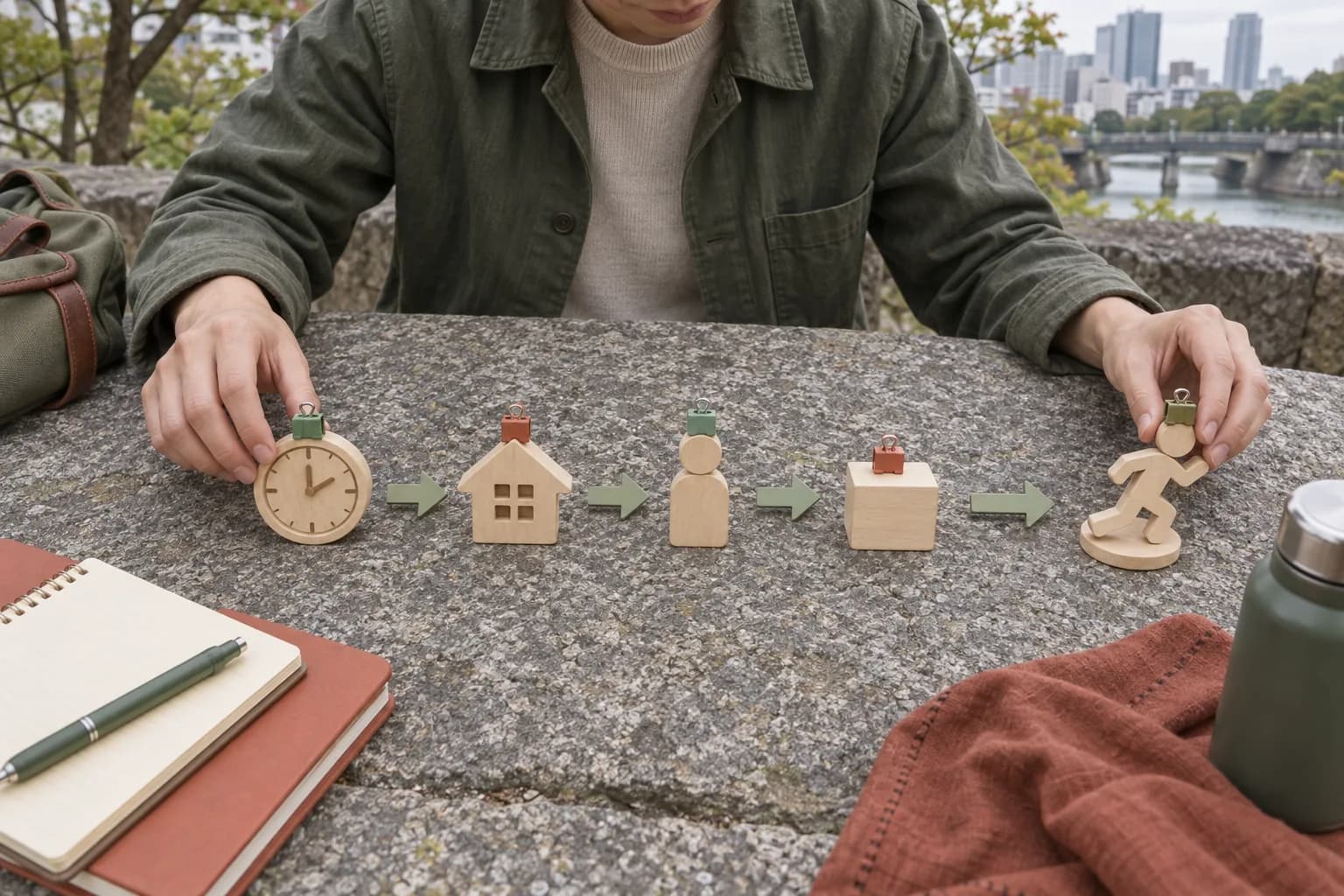
A particle follows a word or phrase and signals how that unit relates to the rest of the sentence. In the model, に keeps 朝七時 connected to the time of the event, で marks 家 as the setting where the action happens, and を marks コーヒー as the object affected by 飲みます. The Japan Foundation’s Irodori grammar notes describe particles as elements placed after words to show their relationship with other sentence parts. That is a more useful starting point than memorizing one English replacement for each particle.
Keep the particle attached when you move or analyze a phrase. [家で] is one working unit; moving 家 alone and leaving で behind destroys the cue. Likewise, に is not always ‘at,’ で is not always ‘in,’ and を is not merely an English object marker in every construction. Learn the relationship in the event: time or destination with に, action setting or means with で, and the object or path marked by を, depending on the predicate.
Test the relationship by changing only one element. 図書館で本を読みます means ‘I read a book at the library.’ 図書館に本があります means ‘there is a book in the library.’ The English location looks similar, but the Japanese event changes from an action to existence, so the particle changes. The predicate and particle must be learned together as a small pattern.

Word order is flexible, but not meaningless
Japanese permits several pre-predicate phrases to change position. 朝七時に私は家でコーヒーを飲みます and 家で私は朝七時にコーヒーを飲みます can describe the same basic event because the particles preserve the roles. The final predicate still anchors the clause. Yet the alternatives do not sound identical in every conversation. The opening position often connects to the current topic, creates a contrast or answers the question being discussed.
If someone asks where you drink coffee, 家では朝七時にコーヒーを飲みます can set ‘at home’ as a contrastive frame. If the question is when, 朝七時に is likely to appear near the beginning or receive spoken emphasis. Grammar allows movement, but information structure chooses the natural arrangement. This is why random shuffling is a poor exercise: it proves possibility without teaching when a speaker would choose the result.
Use question-and-answer pairs instead. Write one neutral sentence, then ask いつ, どこで, 何を or だれが. Move or emphasize the answer while leaving each particle attached and the predicate at the end. Read both versions aloud and state what the listener was already considering. Flexible order becomes a communication choice rather than a puzzle.

Topic and subject answer different questions
The は phrase establishes what the conversation will be about or sets a contrast; it is not automatically the grammatical subject. 私は猫が好きです is often translated ‘I like cats,’ but the structure frames 私は as the topic and marks 猫 with が inside the description 好きです. Treating は as an English subject marker hides why both phrases can appear and makes later sentences seem exceptional.
Use a focused question to see が at work. 誰がこのケーキを作りましたか asks ‘Who made this cake?’ The reply 佐藤さんが作りました identifies the missing participant. Once Sato is established, 佐藤さんは料理が上手です can make Sato the topic and say that cooking is a strong skill. The particles guide different information jobs rather than competing for one subject label.
For beginners, the practical test is conversational. Ask ‘What are we talking about?’ for は and ‘Which participant or thing completes this description or answers this open slot?’ for が. These questions do not explain every advanced use, but they prevent the most damaging shortcut. Keep the whole example and its question; a detached rule about ‘subject’ will not predict the same choices.
Context can remove a phrase, not its meaning
Japanese commonly leaves out information that speaker and listener can recover. After 何を買いましたか, the reply 本を買いました is complete in context: the buyer is already understood. Repeating 私は is possible but often unnecessary. Irodori’s official grammar notes explicitly point out that Japanese need not state things that are clear from context, such as 私 in an introduction where the speaker is obviously talking about themself.
Omission is not permission to delete anything. Remove a phrase only when the listener can identify it from the immediate exchange, shared situation or previous sentence. If three people are being discussed, dropping the actor may create a real ambiguity. Written instructions and formal explanations also repeat information that casual dialogue would leave implicit. Naturalness depends on the information available, not on a rule that Japanese ‘has no subjects.’
Practise with dialogue pairs. Begin with a full sentence, ask a question that makes one element obvious, and shorten the answer. A: どこで勉強しますか。B: 図書館で勉強します. The subject disappears because the participants know who will study. Then change the scene so two possible learners exist; restore a name with は or が as the intended message requires.
Modifiers stay before the noun they describe
Phrase order before a predicate can be flexible, but a modifier must remain before its noun. 昨日駅で買った本 means ‘the book [I] bought at the station yesterday.’ The entire clause 昨日駅で買った describes 本 and ends immediately before it. Japanese does not add an English-style relative pronoun such as ‘that,’ and the role of the modified noun is understood from the clause and the larger sentence.
Add the noun phrase to a complete event: 昨日駅で買った本を電車で読みました, ‘I read on the train the book I bought at the station yesterday.’ Locate the final predicate 読みました first. Then identify 本を as its object. Everything directly before 本 forms the description of that book. This layered reading prevents you from attaching 昨日 or 駅で to the final reading event when they belong to the buying event.
Start with shorter modifiers: 面白い本, 日本語の本, 先生が書いた本. Expand only after the boundary is clear. Draw one box around the modifier and its noun, then a larger box around that noun phrase plus its particle. The nested shape mirrors how the sentence is built and works better than translating from left to right word by word.

Negation, tense and politeness belong at the predicate
Because the predicate closes the clause, crucial grammatical information often arrives late. 私は昨日その映画を見ませんでした remains open until 見ませんでした tells you ‘did not watch.’ Do not assume a positive event from the nouns and adverbs that came first. Hold the frame, then let the final form determine tense, polarity and politeness.
This principle also improves listening. Rather than translating every noun immediately, track the marked phrases and reserve judgment for the ending. 行きます, 行きません, 行きました and 行きませんでした share the event of going but change whether it happens and when. Plain forms such as 行く, 行かない, 行った and 行かなかった carry the same contrasts with a different social style.
Make a four-corner drill from one useful sentence. Keep the phrase frame fixed and change only present affirmative, present negative, past affirmative and past negative at the end. Then switch one marked phrase. This reveals the stable structure without producing a giant conjugation table detached from meaning.
Parse and build sentences with the same five-pass method
For reading, make five passes. First circle the final predicate. Second, underline particle-marked phrases. Third, join any modifier to the noun immediately following it. Fourth, restore only omitted information that the context clearly supplies. Fifth, state the event in natural English without forcing the original order. This method handles the architecture before individual vocabulary distracts you.
For production, reverse the process. Choose a predicate, decide which participants, object, time and place the listener needs, attach the particles, and arrange the phrases according to the conversational focus. Remove what is already obvious. Check that every modifier sits before its noun and that the predicate contains the intended tense, polarity and politeness. Only then refine word choice.
Use the model 私は朝七時に家でコーヒーを飲みます as a weekly template, not a sentence to memorize forever. Change the question, move one complete phrase, omit one recoverable element and expand one noun. Explain what each change does. Japanese structure becomes manageable when you stop hunting for an English slot-by-slot match and start following relationships toward the ending.
Keep the predicate as the endpoint, particles attached to their phrases, modifiers before nouns and omissions accountable to context.