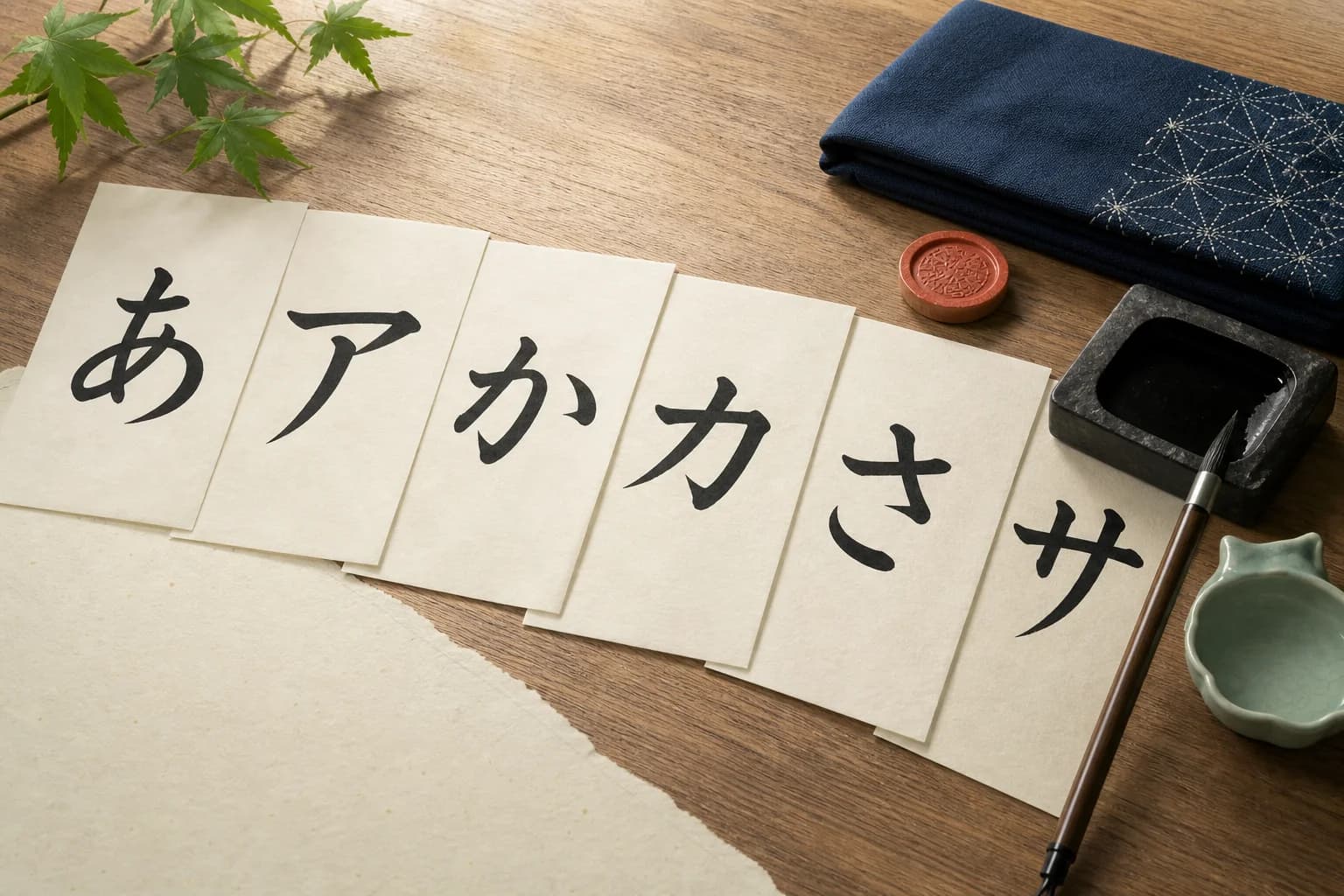
Romaji can help you pronounce your first few Japanese examples, but it becomes a bottleneck when your eyes keep reading the Latin letters instead of the kana. The answer is not to remove every hint on day one. It is to make the hint less necessary each time you meet the word.
A good hiragana routine moves through three stages: connect shape to sound, distinguish similar characters, then read the characters inside useful words and short sentences. The following plan keeps each stage small enough to repeat daily.
Learn five sounds, then use them
Take one row or a smaller mixed set rather than the entire chart. Say the sound, trace or write the character once or twice, then identify it among nearby alternatives. Stop looking at the chart before you feel completely ready so recall has a chance to work.
Use the available characters in short words as soon as possible. Even two or three readable words give the shapes a purpose and prevent the chart from becoming an abstract visual puzzle.
The goal is not to finish the kana chart. The goal is to see a character and hear its sound without an intermediate alphabet.
Practise confusing pairs directly
Characters such as さ and ち, ぬ and め, or れ and わ are easier to distinguish when shown together. Describe the feature that separates them, then answer rapid mixed prompts instead of reviewing each one in a separate block.
Do the same with sounds that feel close in your first language. Short audio choices train the connection from sound to symbol, not only from symbol to an English syllable.
- Look and say the sound
- Hear and choose the character
- Write from sound
- Read it inside a word
Fade romaji deliberately
Show romaji only after an attempt, not beside the kana from the start. On the next review, delay the hint longer. Once a word is stable, remove romaji completely and keep audio plus meaning as the support.
If reading becomes painfully slow, reduce the number of new characters rather than restoring romaji everywhere. A smaller set read directly builds the habit you need.
Finish with two minutes of real reading
Use a tiny dialogue, menu line, caption or graded sentence containing mostly familiar kana. Read once for sound, once for meaning and once with the audio. Mark only the characters that actually interrupted the sentence.
This final step changes kana from a memorization project into a reading system. Speed will develop through frequent successful passes, not by staring at the chart longer.