
Trying to learn Japanese after a break often begins with the wrong question: how can you recover the streak you lost? The number has already changed. What remains useful is your material, your previous experience and the opportunity to make one clear attempt today. Opening an old course can still feel uncomfortable when its lesson number looks advanced but a basic word will not come to mind. That mismatch is a reason to inspect your starting point, rather than either abandoning the course or restarting every page from zero.
This guide gives you a return process that works with an existing textbook, recordings, a notebook and whatever review tool you already use. First identify what interrupted study, then choose one useful task and stop at a planned boundary. The suggested durations are examples to adjust, not scientifically proven recovery targets. A pause caused by a busy week and a pause lasting several years need different workloads. Both can begin with an honest check of what you can currently understand and use, followed by a next session that fits your present circumstances.
Learn Japanese after a break without turning time into debt
Separate the missed calendar days from the language work in front of you. Seven missed sessions do not automatically require seven extra sessions before you may continue. The course bookmark records where you stopped; it does not prove that every earlier skill is secure or that every later lesson is now unsuitable. Keep the bookmark, but treat it as a clue. Your next decision is which task will provide useful evidence of your current ability. That decision can be small enough to make today, even if the wider study plan needs revision.
Write a neutral description of the interruption: a change in working hours, travel, difficult material, an expanding review queue or a routine that depended on an unrealistic evening slot. Avoid a general verdict such as ‘I lack discipline’, because it offers no specific change to test. If the problem was opening five resources before starting, prepare one. If it was a lesson that exceeded your available time, choose a shorter part. You are changing the conditions of the next attempt. You do not need to erase previous progress, promise daily perfection or catch up with an imagined uninterrupted version of yourself.
Build a start cue around the life you have now
Choose a situation that already occurs and name the material you will open there. ‘After breakfast, I will open the bookmarked dialogue at the kitchen shelf’ is more actionable than ‘I will become motivated again’. Check whether the location is actually usable: listening on a noisy platform and speaking beside sleeping family members create different constraints. Place headphones, the page or a pencil where they will help. If your schedule rotates, anchor the session to an event such as arriving home rather than to a clock time that exists only on certain days.
Do not attach a habit deadline to this arrangement. In a University of Surrey interview, habit researcher Phillippa Lally explains that formation times vary widely and that clear plans specify when and where an action happens. Her discussion concerns habits generally, not a guaranteed timetable for Japanese learning. Use the insight to make the next start concrete. Keep a primary opportunity and one realistic fallback, such as the following morning. If neither happens, investigate the cue or workload instead of announcing that the whole plan has failed. A workable cue should help you begin the learning task, rather than create another rule to feel behind on.

Choose one useful outcome for the return
Replace ‘get good at Japanese again’ with an outcome you can observe in a short task. You might want to understand a familiar invitation, give a simple description of your morning or read the main point of a short course message. Select something connected to your reason for learning. An upcoming trip may make everyday exchanges relevant; returning to a class may make its current lesson the best starting place. The Japan Foundation describes Irodori’s Can-do goals through practical communication in real situations. That gives you a useful model for framing your own small outcome, without turning this restart plan into an official curriculum.
Define what would count as completing the task and what support is allowed. For a familiar message, completion might mean identifying who is meeting whom and when, then checking the answer against a translation. For a spoken response, it might mean producing two relevant ideas before consulting the model. Avoid adding handwriting, perfect pronunciation and every unknown word to the same first goal. Those may deserve later practice, but they can hide whether the original task was manageable. Choose one main outcome and record one limitation. That is enough information to guide the next visit without making today a comprehensive examination.
Find an entry point with a small sample
Open the last material that once felt understandable and select a short sample: a few lines with its audio, one familiar question and one changed detail to answer. Try the reading and listening before revealing the explanation. Then attempt the answer without copying its model. This is a practical placement check, not a standardized level test. Mark each part as independent, possible with support or currently blocked. A single successful sample cannot establish your entire level, but it can tell you whether this particular lesson offers a useful next task. Keep the result specific to the activity you actually attempted.
Move back only as far as the obstacle requires. If you understand the dialogue but cannot recall its response, review that response and continue from a supported attempt. If most of the sentence structure is unclear, try an earlier lesson that introduces it. If kana recognition blocks every line, set aside a bounded script review before returning to the dialogue. A longer pause may justify a teacher’s placement advice or several samples across skills. Preserve your previous notes while making that decision. Starting from a simpler activity is a choice about the present task, not a declaration that all earlier learning has disappeared.
Give the first session a clear finish
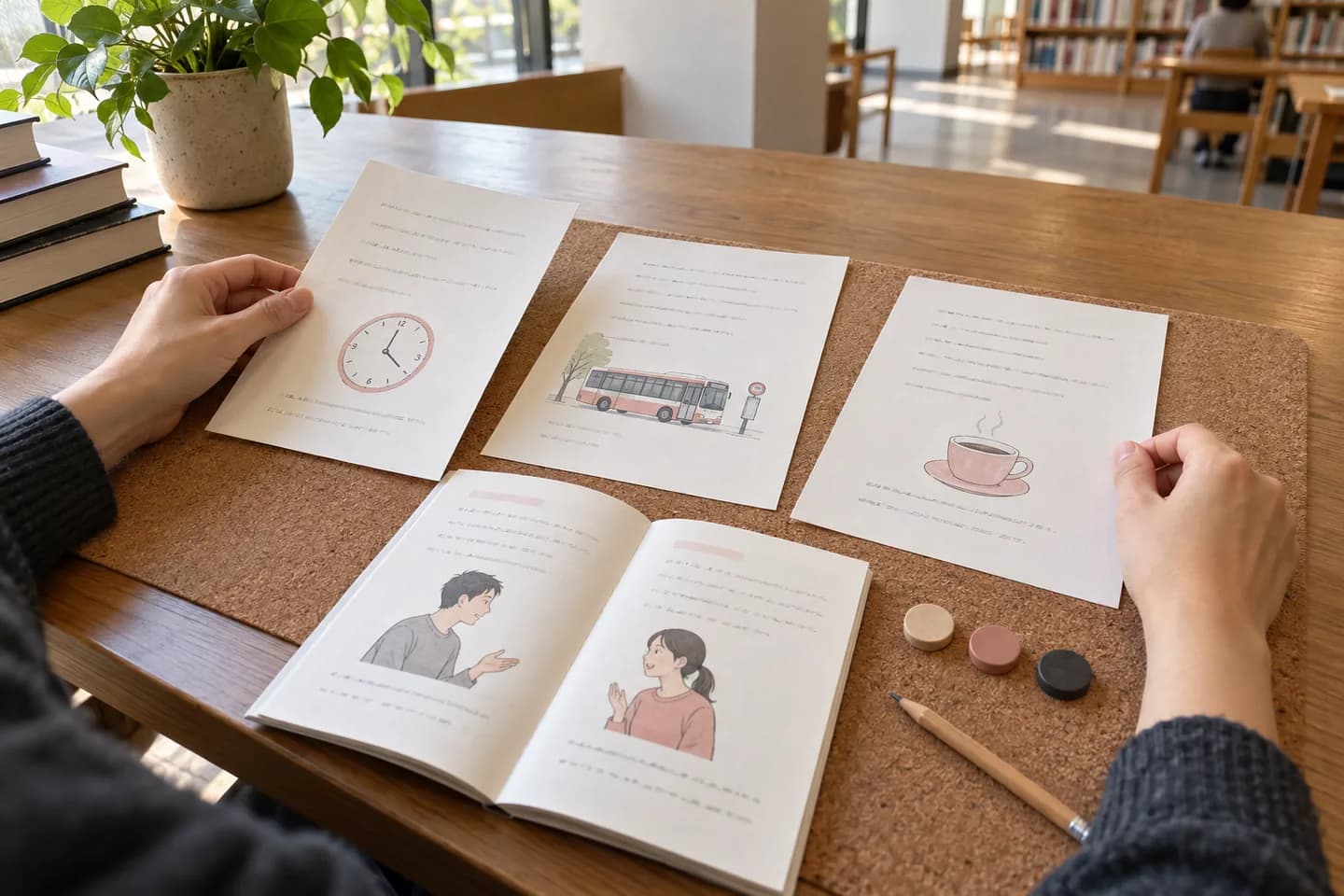
Prepare the task before beginning so that searching does not consume the whole session. For example, allow twelve minutes for one familiar dialogue: a brief first listen, a check of the main meaning, another listen with the text and one answer using a changed detail. If the recording is long or the material is difficult, shorten the sample rather than speeding through it. Consult an explanation for the point that prevented understanding. Then close the model and try again. The purpose is to complete one coherent learning action with feedback, rather than sample several resources without reaching a result in any of them.
Finish by leaving a useful bookmark. Write the page or recording, what you managed, one unresolved point and the exact task for next time. ‘Listen again and answer the second question without the text’ is a better return instruction than ‘do more Japanese’. Stop when the planned action is complete, even if there are more pages available. If you have extra capacity, choose an optional extension with its own finish. Do not quietly redefine the minimum session after an unusually energetic evening. The plan needs to remain possible on an ordinary day, when opening the material is less exciting and your available attention is smaller.
Reduce the review queue without deleting the evidence
An overdue review counter can make returning feel like administrative work before learning may begin. Inspect a small sample rather than assuming every item requires the same treatment. Some words remain usable, some need their sentence or audio, and some belong to material you no longer intend to study. Keep useful items connected to the current lesson. If your tool supports pausing new additions, consider doing that while you establish a manageable review amount. Use its documented controls and preserve existing records; do not guess how a reset changes scheduling or treat indiscriminate deletion as the default solution to a large queue.
Set a boundary around review so that it leaves room for the main task. You could choose a short time allowance or a small group relevant to today’s dialogue, then reassess based on actual difficulty. Neither number is a universal ideal. A failed item should lead to a focused repair: check its meaning and reading in context, make one attempt and return through the tool’s normal process. Avoid repeatedly selecting an easy answer merely to reduce the counter. If you use paper, make a small active pile and leave the rest organized for later. The aim is a queue that serves the next learning task, with decisions you can explain.

Use the next few visits to test the plan
Keep the first few visits comparable enough to learn something about your routine. Return to the same small course area and use the previous note to begin. Observe whether the cue happened, whether the task fit and where support was needed. Once the sample is manageable, add one nearby activity or the next short lesson part. Change one demand at a time so that you can see what made the session harder. You need not wait for everything to feel effortless, but repeated confusion or rushed completion is a reason to reduce or clarify the task before expanding the workload.
Track evidence of language use alongside attendance. A note such as ‘understood the invitation without its translation’ tells you more than a checked calendar square alone. Attendance can still be useful information, especially when you are testing a new time slot. Keep the two measures distinct so that an easy login does not substitute for study and a difficult session does not look worthless. The coming KanaWay app may eventually organize learning encounters, but this return process works with materials you already have. A tool can support the routine; the observable task, helpful correction and realistic return opportunity remain the essential parts of your plan.

Decide now what happens after the next missed session
A return plan should include an interruption rule before another interruption arrives. If you miss the primary opportunity, use the fallback and open the same bookmarked task. Do not double the workload as punishment. If repeated misses show that the cue is unreliable, move it. If the task is consistently too demanding, reduce its scope or seek an explanation. If the reason for learning has changed, update the goal rather than preserving an obsolete schedule. A planned pause is also a valid decision: keep the material organized, leave a restart note and choose a date to reconsider your available capacity.
At that reconsideration, judge the plan by what you actually did and learned. Keep the part that made starting straightforward, revise the part that repeatedly prevented completion and choose one next outcome. You may decide to resume the old course, work at an earlier entry point or ask a teacher to help place you. Make that choice from observed tasks rather than from the length of the lost streak. Your next useful step can be modest: open one known page, attempt one meaningful activity and leave a clear instruction for returning. That is a concrete way to continue learning from where you are now.