
You can learn Japanese offline during a flight or commute, but only if the session has a smaller goal than 'study Japanese until I arrive.' A downloaded folder full of lessons is preparation, not practice. Choose one useful situation, one short audio or passage, and a few words you can retrieve without a connection. Then decide what you will attempt before seeing the answer. This makes a fifteen-minute train ride useful and keeps a long flight from becoming an exhausting series of random taps.
The routine below starts before departure, continues through an interrupted journey, and ends with one new use of what you studied. It works with paper and downloaded files. KanaWay, an upcoming app, can connect the same steps through its planned offline lessons, audio, dictionary, saved words and review. The app should reduce friction, not decide what the learner has understood. The test is whether you can recognize, explain or use something after the screen or worksheet is closed.
Learn Japanese offline by packing a task, not a library
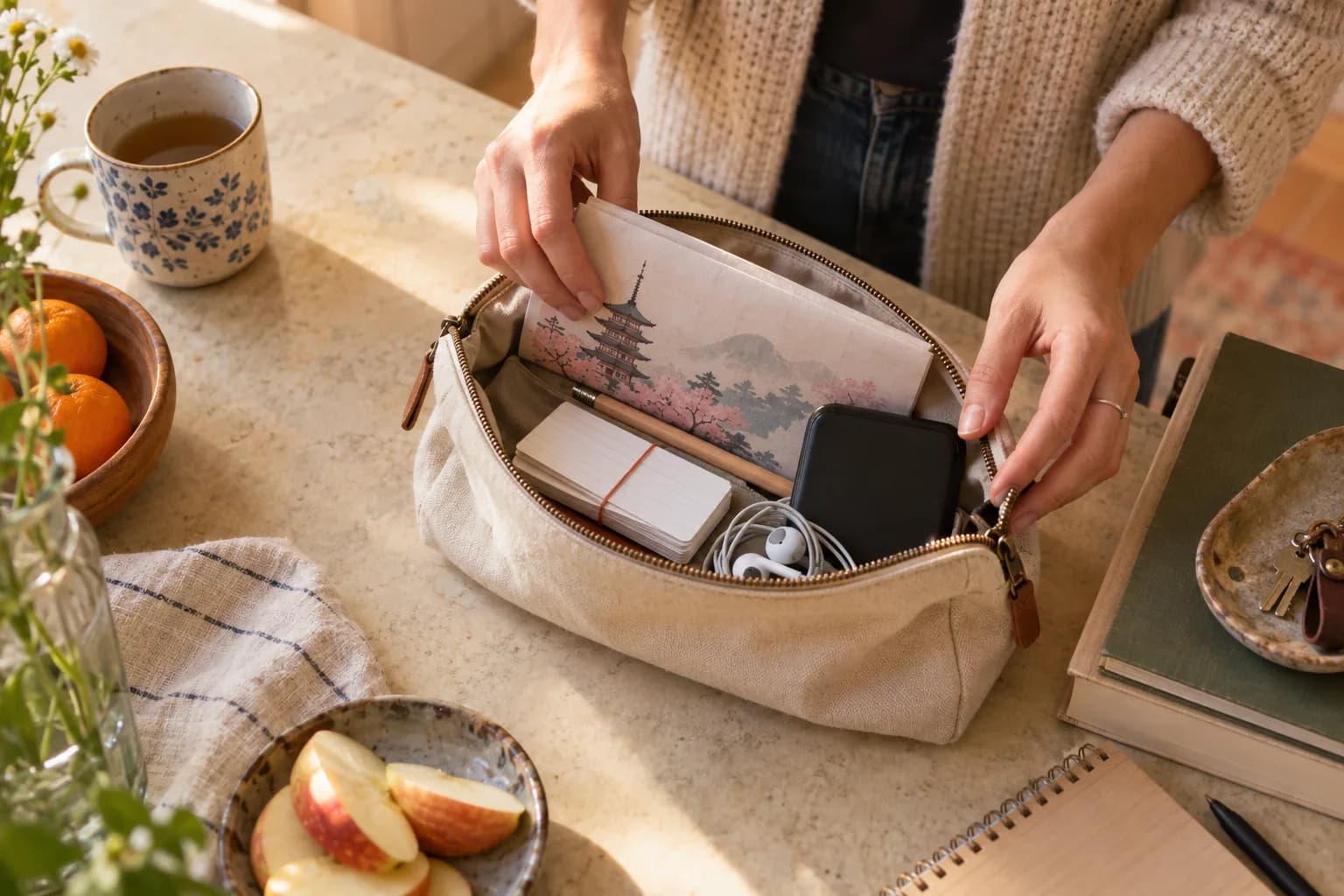
Before leaving, pick a situation you might actually meet: finding a platform, ordering a drink, asking when a shop closes or reading a short message. Pack one compact lesson or passage, its audio if available, a way to see a transcript after an attempt, and a place to record two or three misses. Download them over a reliable connection and open each file once while online. A filename alone does not prove the audio is cached. If you expect poor battery or no device access, carry a small paper card with the same example and a pencil. One complete activity survives travel better than a large collection that requires browsing.
The Japan Foundation's Irodori download page makes this distinction concrete: lessons are offered as PDFs and separate MP3 ZIP files. It also warns that audio embedded in certain PDF files is meant for a PC with Adobe Acrobat Reader, not playback on a phone or tablet. If you intend to study on a portable device, check the separate audio files before departure rather than assuming the PDF's audio button will work. The official lesson material gives you a dependable text-and-sound pair; it does not choose your question or ensure that you have made an active attempt.
Choose a target that fits the length of the journey
For a ten-minute commute, choose one outcome: catch the time in a short announcement, identify the final verb in a message, or recall three saved words in new phrases. For a flight, use several separate rounds with breaks rather than enlarging one exercise until attention collapses. Estimate the usable minutes, not the timetable duration. Boarding, transfers, announcements and fatigue take time. A practical plan names a start cue, a task and a stopping point: 'After I sit down, I will listen twice, check one line and put the materials away.' This is easier to resume than a vague plan to finish a whole unit.
Match the target to the medium. Audio is suitable when you can hear safely and comfortably; a paper sentence works when headphones are inconvenient; silent recall works in a crowded carriage. Do not rely on mobile data for a dictionary lookup you know the task will require. Save the needed entry or carry a small word list, but keep answers hidden until after an attempt. The planned offline session should remain useful even if the phone is in airplane mode, the signal vanishes in a tunnel or you have to stop halfway through a sentence.
Attempt the audio before opening the transcript
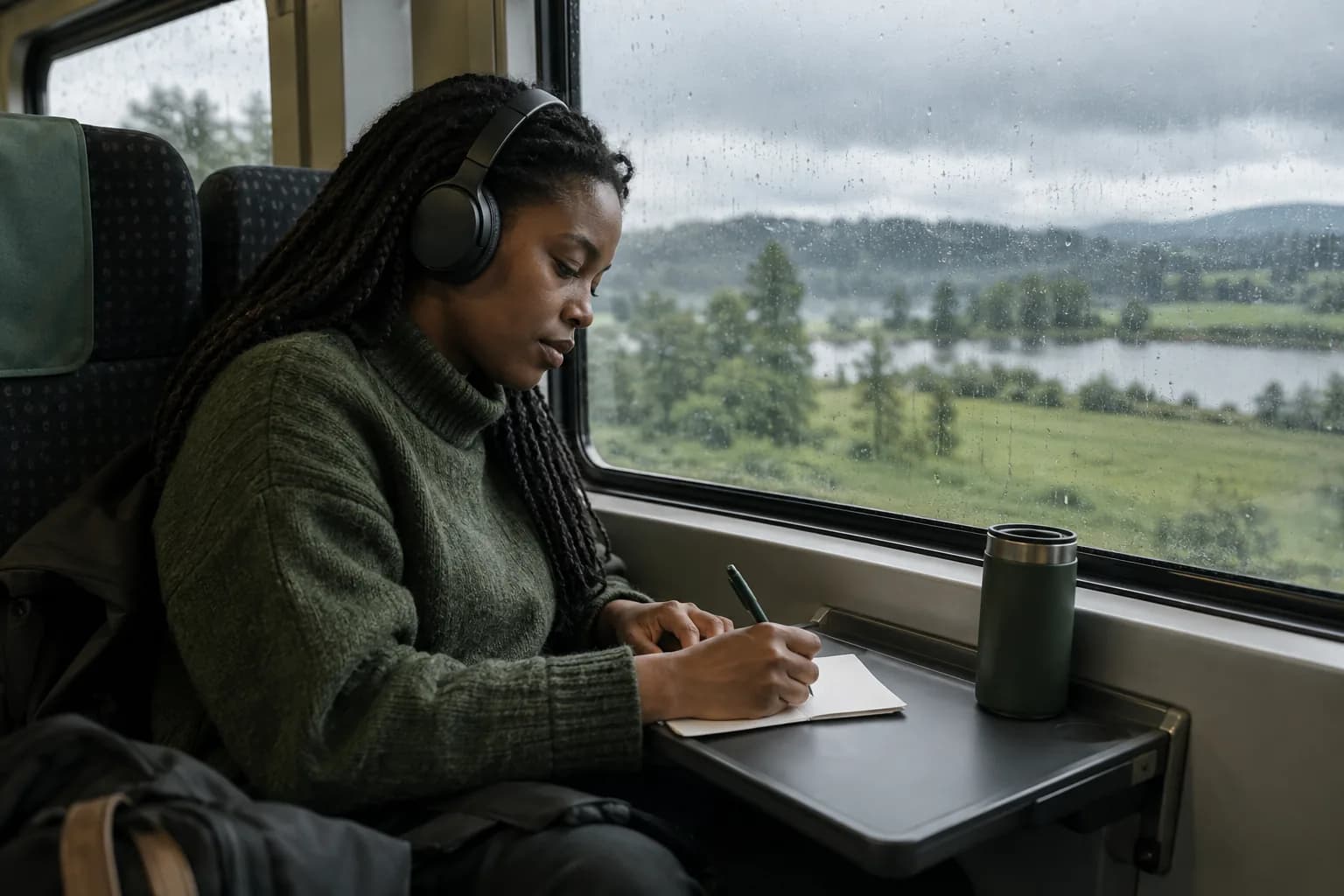
Give the first listen a question. If the clip is about a meeting, listen for the place or time, not every syllable. After one play, say or write the best answer you can. On the second play, listen for the part that supports or corrects it. Only then open the transcript. The transcript can show whether you missed a word boundary, an ending, a familiar expression or the whole context. Copying the complete dialogue is unnecessary if one line contains the obstacle. Rewind that line, listen again and then hear it inside the full clip once more.
Travel audio is easily confused with background noise. Listening while half-asleep or scrolling elsewhere may feel productive without producing any checkable result. A tiny question makes the difference observable. If the environment is too loud, switch to a silent text task rather than turning the volume up indefinitely. If the audio is too hard, choose a shorter or simpler recording for the next round. If you understood the main answer but not one side detail, finish the task before investigating it. Offline practice improves when you can name exactly what the attempt showed.
Use the gap between stops for active recall
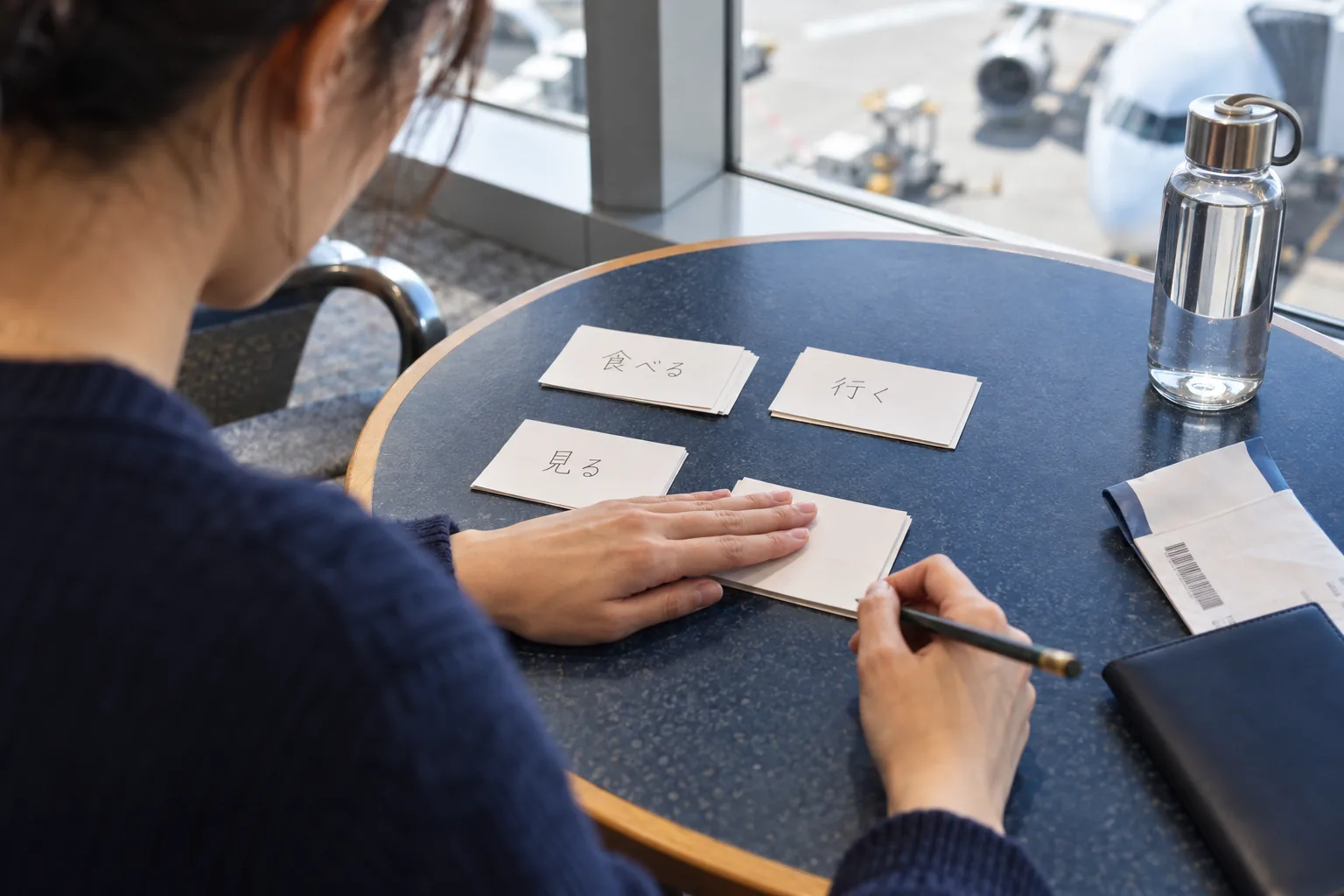
A brief recall round can run without sound, signal or a large screen. Cover the answer side of three cards and retrieve a word, reading or short response from the prompt. Say it quietly or write it; recognition after revealing the back is not the same as recall before it. Make the prompt specific enough to have a clear answer. A card that shows only an English word may invite several valid Japanese expressions. A short situation, such as asking where the exit is, gives the answer a function. Keep the round small enough to stop when your station approaches.
After revealing, sort each item. Correct and quick goes back for later review. Correct after a long hesitation needs another attempt in a different phrase. Wrong because the prompt was ambiguous should be rewritten, not drilled harder. Wrong because the reading or verb form was unavailable gets a trustworthy model sentence. On a flight, you can return to these few misses after a break; on a commute, save them for the next ride. The point is to collect evidence about retrieval, not to clear a large queue for its own sake.
Use KanaWay to connect lesson, lookup and review
KanaWay is still upcoming. Its planned offline path can keep a short lesson, audio, a saved vocabulary item and a dictionary lookup near one another when the network disappears. Begin with a lesson tied to one travel situation. Attempt the listening or sentence task before asking for help. When a word blocks the answer, use the offline dictionary to check that word, then return to the original line. Save it for later review only if it matters to your goal or recurs. A lookup should repair the lesson, not become a detour through every possible meaning of a character.
After feedback, make one new response. If the lesson asks about a train departure, try a different time or destination in the same pattern. Later review should ask you to retrieve the useful relationship, not just recognize the exact old screen. This is the role an app can play: preserving the thread from explanation to attempt, correction and later encounter. It cannot guarantee that every downloaded item matches your level, and it cannot replace a real exchange with a person. Paper cards and separate audio files can support the same loop today if that is what you have available.
Handle interruptions without losing the thread
A journey is not a quiet classroom. An announcement can cut into a clip, a transfer can end a reading pass, and another passenger may need your attention. Build each round so it ends with a small record: the question you were answering, your provisional answer and one next step. If interrupted, write 'check the final verb' rather than leaving an unmarked page open. When you return, replay the short segment or reread the sentence before looking at the answer. This takes seconds and restores the context that vanished with the interruption.
Plan a fallback for common failures. If headphones stop working, move to text and recall. If the battery is low, use the paper card. If motion makes reading uncomfortable, stop and resume later; practice that makes you ill is not a good routine. If your download was incomplete, do not turn the trip into repeated connection attempts. Work from the one item that opens reliably. A robust offline plan is not a perfect schedule; it is a few choices that still let you finish a meaningful attempt when conditions change.
Finish with one sentence that belongs to your trip
Before putting the material away, connect it with a real observation. If you studied departure language, note a time from your own route and produce a short Japanese sentence using the pattern. If you studied ordering, imagine a different item you could ask for. Do not invent a complicated story to prove that the session worked. One accurate variation shows more transfer than copying ten examples. If you cannot make the sentence yet, record the missing verb or particle as the next question. The output can be spoken, written or mentally rehearsed when circumstances do not allow either.
After arrival, check the sentence against a trustworthy model or ask for correction if someone is available. Then read or hear the original example again. A successful offline session has a trace: a question attempted, one gap repaired and one small use beyond the initial prompt. The trace is more useful than a streak that records only minutes. If the task was too easy, raise the next target slightly. If it required constant lookup, simplify it. Travel time is variable; the learning loop can remain steady even when the available minutes are not.

Prepare the next offline session from today's evidence
At the next connection, do not automatically download a larger bundle. Review what today's attempt revealed. Which clip was understandable after a second listen? Which word remained unavailable without its answer? Which sentence could you adapt to your own situation? Keep the material that produced a useful question. Replace a task that was consistently too dense. Download one new example that changes the context while retaining a word or pattern you want to use again. That creates continuity across journeys instead of a pile of unrelated files that never become familiar.
For tomorrow's ride, write a small instruction you can follow even without motivation: 'Listen for the destination, attempt two saved words, then make one new sentence.' Check that the audio and text open in airplane mode before leaving. Keep the paper fallback in the same pocket. Whether you use the official downloaded Irodori materials, KanaWay when it becomes available, or your own cards, the principles remain the same: prepare one achievable task, attempt before revealing, repair a specific gap and carry the language into a new context. That is how disconnected minutes become connected learning.