
Ne and yo in Japanese can change how a familiar sentence reaches another person. You may know every word, attach an ending you have heard often and still make an observation sound like a correction. The learning problem is not finding one English translation for each particle. It is deciding what you are doing with the listener: sharing a reaction, checking an assumption or drawing attention to information.
This independent guide uses short polite sentences, paper situation cards and a reliable reference. You will compare the same statement in different contexts, listen beyond the final syllable and check what a partner understood. No app is needed. The examples are starting points for a limited practice task, not rules for every conversation. Keep the whole exchange visible: who is speaking, what the other person already has access to and why the statement matters now.
Ne and yo in Japanese need a listener and a purpose
Begin with a small question in your own language: why am I saying this to this person? If both of you are noticing the same thing, a shared reaction may fit. If you are correcting a mistaken assumption, the task is different. Write that purpose before selecting a Japanese ending. A particle chosen because it sounds familiar can hide the fact that you have not decided what your contribution should accomplish.
Tokyo University of Foreign Studies describes ね as a resource for confirmation or agreement and よ as drawing the listener's attention to the message. Treat that as an initial contrast, rather than a mechanical rule based only on who knows a fact. A conversation contains assumptions, relationships and a particular next turn. Those can change what an otherwise identical sentence does for the people involved.
For your first exercise, use peers in an ordinary setting and keep the polite sentence style stable. Do not compare an informal line from a drama with a formal classroom answer and blame every difference on the particle. Note the people, setting and intended purpose on a small paper card. Then find a checked model that actually matches that situation before attempting a change yourself.
Try ne with something both people can notice
Imagine two people outdoors on a hot day. 暑いですね, read あついですね, can invite a shared response to the heat: it is hot, isn't it? The English wording is only a contextual gloss. The practical point is that you are turning an observation toward the other person and leaving room for a response. Do not learn the particle as an automatic decoration for the adjective.
For a paper exercise, select a simple shared scene and state what both people can perceive. One person offers the checked observation and the other responds naturally within the model you are using. Afterwards, ask whether the first turn invited agreement, checked a detail or introduced something unexpected. Keep the discussion about the exchange rather than scoring one syllable as correct in isolation.
If the adjective is unfamiliar, resolve that vocabulary problem separately. Read the short sentence without adding several new descriptive words. You should be able to explain the observation before judging its conversational role. A known sentence with a clear purpose is more useful here than an elaborate description whose ending you cannot interpret. Keep the initial practice ordinary enough that the listener does not have to guess the intended scene.

Try yo when the information needs the listener's attention
Now use a deliberately fictional calendar situation: tomorrow is Sunday, and a friend has planned something as though it were a weekday. あしたは日曜日ですよ, read あしたはにちようびですよ, draws attention to that information. A suitable English rendering in this setup is tomorrow is Sunday, you know. This is a constructed practice situation, not a statement about the day after this article's publication date.
Change the setup while keeping the basic information stable. In one card, the friend needs the reminder. In another, both people already have the same calendar open and you are checking a shared understanding. Ask what contribution the speaker wants to make in each case. Do not simply assign an ending by whether the calendar is physically visible. The purpose of the turn still matters.
A helpful exercise is to let the listener explain what they thought the speaker was doing. Did it sound like a reminder, a correction or an invitation to confirm? If their interpretation differs from your intended card, keep that discrepancy for discussion. You are examining a conversational choice, not claiming that a single particle can force every listener to hear the exact same attitude.
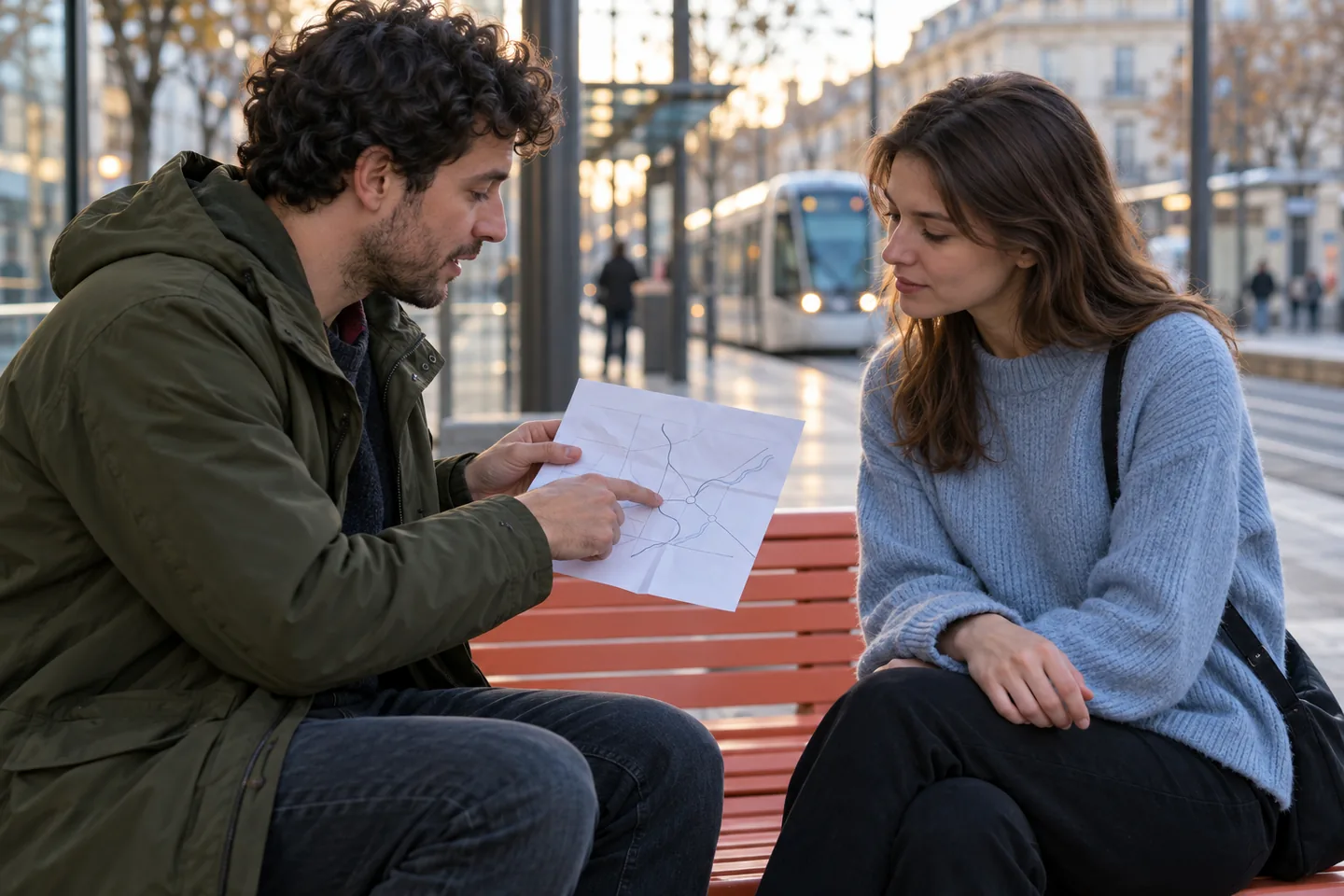
Keep the statement stable while changing the situation
For a contrast with the fictional Sunday example, use あしたは日曜日ですね, read あしたはにちようびですね, in a context of checking or sharing that understanding. The event information stays the same; the relationship of the utterance to the listener changes. This lets you practise the choice without simultaneously learning a new verb, a different date and a new sentence structure.
Put the two scene descriptions on separate cards, with no Japanese answer on the front. Explain the scene, choose the checked sentence and then justify the choice in ordinary language. If you cannot say why you are speaking, reread the situation instead of memorising a fixed card order. Rearrange the cards so that their position cannot supply the answer. Keep the explanations brief enough to compare.
After a few attempts, ask a partner to alter one detail: the listener has forgotten the date, already agrees or is checking it with you. Discuss whether the old response still fits. This is an original practice framework, not a formal test with one universal answer key. A reliable speaker or teacher can help explain alternatives that your beginner contrast does not yet cover.
Do not turn ne or yo into a politeness switch
A sentence ending is part of an exchange, not a guarantee that your message is friendly. The Japan Foundation highlights the importance of situation, relationship, style and intonation when considering final particles. That is why a useful beginner model needs its context. Adding an ending to every line will not replace deciding what you want the other person to understand or how the sentence fits the previous turn.
Keep the politeness level of the example stable in this session. If your source uses a short polite statement, practise that complete statement before exploring plain speech. Do not remove or change other parts just because a subtitle used a shorter line. You would then be changing more than one variable and might no longer know which feature affects the impression you are trying to compare.
When unsure in a real conversation, use a familiar expression appropriate to the relationship and seek feedback later. Save ambitious experiments for a practice situation where everyone knows the task. This is a learning boundary, not a claim that one ending is forbidden with a whole category of people. The more specific your question to a teacher, the more useful their explanation can be.
Listen to the whole turn before copying its ending
Choose a brief, supported dialogue where you know who is speaking and why. First follow the exchange without trying to count particles. On a later pass, notice the sentence ending and compare it with the surrounding information. A clipped syllable detached from its turn removes the evidence you need to understand the speaker's purpose. Keep the transcript available for checking, but make an initial interpretation before opening it.
Use a paper record with three short notes: what the speaker said, what prompted it and what the listener did next. You do not need to transcribe an entire scene. Select one complete turn and the response it received. If you missed the main word, repair vocabulary before drawing a conclusion about the ending. Recognising ね or よ does not establish that you understood the message.
When repeating the model, listen to its delivery rather than inventing a universal rising or falling tune from the printed kana. Compare the complete phrase to the recording and ask a qualified listener about one specific uncertainty. Keep any observation tied to that example. Do not turn a single actor's performance into a rule for all voices, all situations or every instance of the same particle.
Check what the next speaker understood
In pair practice, give the speaker a situation card while the listener sees only the basic scene. The speaker uses a checked line; the listener then explains what it seemed to do. Compare that account with the original intention before discussing pronunciation. If the listener heard a correction when the card called for shared confirmation, that is a useful question to investigate with the full exchange visible.
Do not make the listener agree merely to complete the drill. A response that reveals a mismatch can be more informative than a rehearsed answer delivered automatically. Let the partner ask for missing scene information in your shared language. Then repeat the short exchange after making the intention clearer. Keep changes small so you can tell whether the repair concerned the scenario, the chosen line or its delivery.
Working alone, write your intended purpose under the card, cover it and later explain the same scene again. Compare your reasoning with the reference before producing the sentence. This does not replace feedback from a proficient speaker, but it can reveal that you are selecting by habit rather than by context. Preserve uncertainty as a question instead of declaring every plausible answer equally suitable.

Build a small routine and recognise its limits
A complete independent session can use two situation cards, a checked sentence pair and one supported listening example. Establish the intended purpose, attempt a line, compare the interpretation and revisit a changed scene later. Keep a short record of the uncertainty that remains. More repetitions are not automatically useful when you are still unclear about who is speaking or what the previous turn established.
Progress means being able to explain a choice with reference to the exchange and to recognise when your starting contrast is insufficient. You do not need to solve every combined ending, dialect or informal style in one lesson. If a new example resists the simple explanation, keep its context and ask about that specific case. Expanding the model carefully is better than forcing the conversation into a translation rule that no longer fits.
KanaWay remains an upcoming app. Its described grammar and listening areas may support later study, while the card exercise here works with paper and authoritative examples. No release date, automatic conversation judgement or learning result is promised. Finish by explaining what the listener should take from each of your two cards. That practical decision gives the small ending a purpose beyond sounding more conversational.