
Small tsu in Japanese becomes easier to practise when you stop searching for a hidden syllable. You can recognise っ on the page and still shorten the consonant when speaking. Or you may carefully pronounce an extra tsu and turn a small timing feature into a new sound. Neither problem is solved by staring at a kana chart for longer.
This guide separates three jobs: spotting the small character, hearing the longer consonant, and producing it inside a word. You need a reliable human recording, a few familiar items and somewhere quiet to listen. A notebook and your ordinary device recorder are optional. The exercises work independently of any app, and the aim is intelligible distinctions rather than a perfect accent or a numerical pronunciation score.
Small tsu in Japanese belongs to the next consonant
The full-size hiragana つ and katakana ツ represent tsu. Their smaller forms, っ and ッ, normally mark consonant length before the following kana. In the familiar word 切手, read きって, meaning postage stamp, do not pronounce ki-tsu-te. Prepare the t, keep its closure briefly, then release into te. The spelling points you toward the following consonant rather than supplying a new vowel.
The term sokuon refers to this feature. Roman letters often show it with a doubled consonant, as in kitte. That doubling is a useful reminder, but it is not an instruction to say two separately released t sounds. Think about one held articulation. An English spelling analogy can get you started, yet a Japanese recording should remain the model for the whole word.
Before speaking, compare つ with っ in the font you are using. Do the same with ツ and ッ. If the difference is unclear on a small screen, enlarge the text rather than guessing. Reading the wrong size is a visual problem; losing the duration after reading correctly is a different problem. Give yourself the appropriate task instead of treating both as general bad pronunciation.
Count timing positions without making speech mechanical
Compare 来て, read きて, the te-form of come, with 切手, read きって, postage stamp. The first has two morae, き・て; the second has three, き・っ・て. A mora is a timing unit, and the small character occupies one in this analysis. The words also have their own pitch patterns, so do not assume that every audible difference between recordings is consonant length.
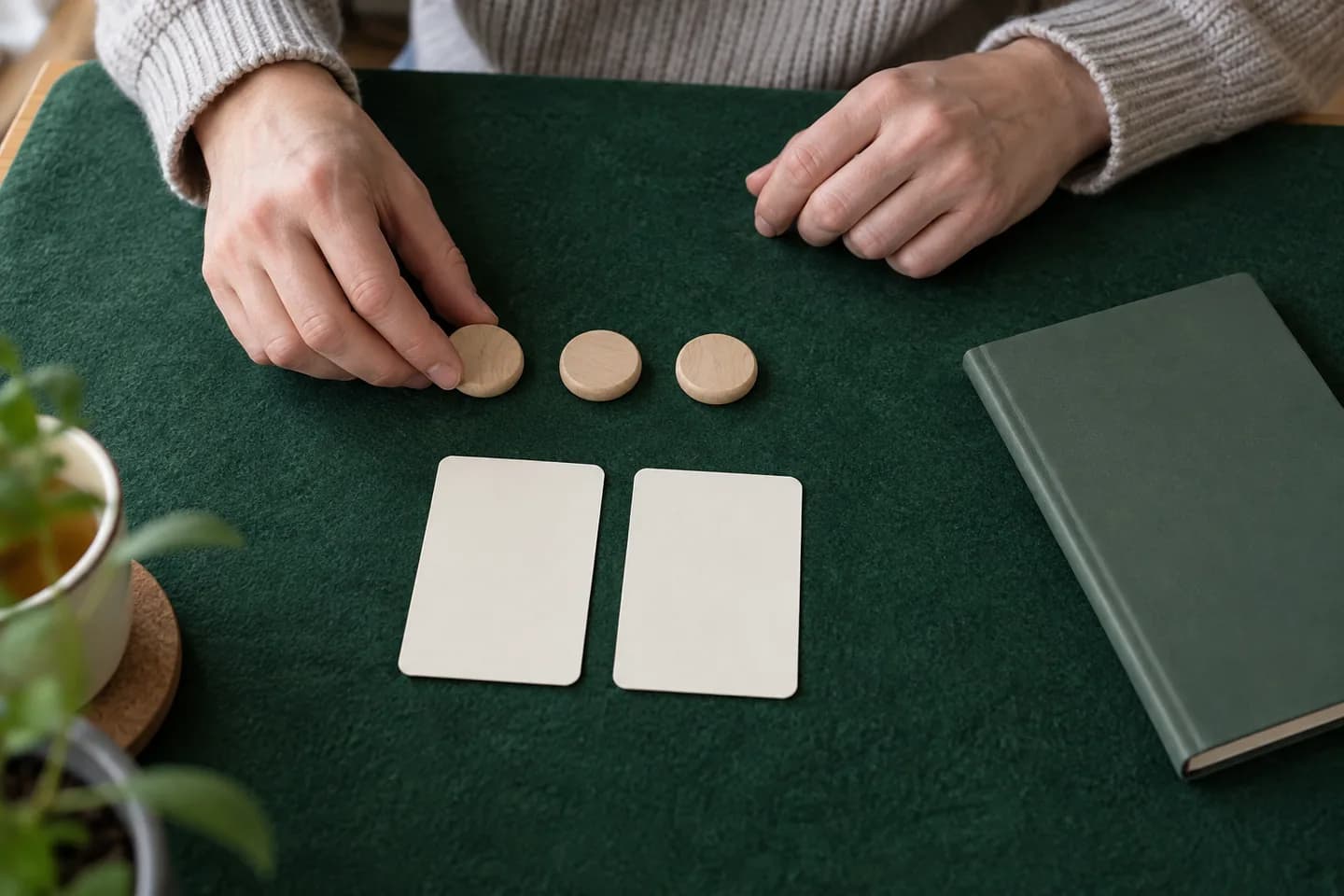
Place two counters beside one card and three beside another. Point through the positions while listening to a clear model. At the middle position of きって, resist adding a spoken vowel. The counter makes room for the closure; it does not label a separate tsu syllable. Start with a comfortable pace at which you can retain that distinction without tensing your throat.
Remove the counters after a few attempts. Natural speech is not a machine with identical milliseconds for every unit, and a slower model is not a universal duration rule. Counting is a temporary aid to prevent an omission. Your later check is whether the word still has its recognisable consonant pattern when you say it smoothly, not whether you can maintain an artificial metronome.
Hold the right articulation, not a louder sound
For a t example such as きって, form the ordinary t closure and delay its release. Do not open the mouth to insert an extra sound between ki and te. Keep the movement small and comfortable. Increasing loudness or striking the second part dramatically can conceal the problem rather than repair it, because the target here is duration within the word.
Different consonants require different movements. A p closure involves the lips; a k closure is made farther back in the mouth. Follow a human model and practise the ordinary consonant first if its articulation is unfamiliar. You do not need to press hard, hold your breath for a long time, or create a strained throat stop. If you feel discomfort, stop and return to ordinary relaxed speech.
A mirror can help you notice whether the lips reopen too early during a p closure. It cannot certify your timing, and it will not show every tongue movement. Use it for one observable question, then listen again. The useful feedback is specific: an inserted vowel, a premature release, or an overlong hold. Correcting one of these is more practical than labelling the entire attempt wrong.

Do not turn every small tsu into silence
The common description “a little pause” is useful for some stop consonants, but it is incomplete. With a fricative, the longer part can contain continuing friction rather than a fully silent gap. Research on Japanese geminates explicitly distinguishes these realizations. Therefore, an instruction to stop all sound at every small っ would teach the wrong movement in some words.
When your chosen word contains an s or sh sound after the small character, listen for sustained consonant noise. Compare that with a stop example from the same teaching resource. Use a recording of a real word whose spelling and meaning you have checked, rather than inventing a Japanese-looking combination. You can practise a sustained hiss as an articulation exercise, but do not present that exercise as vocabulary.
The shared idea is longer consonant time, while the physical realization depends on the consonant. Keep this distinction on your practice card: closure for the stop example, sustained friction for the fricative example. You need not learn phonetic symbols to use that reminder. Once you can hear the difference, return to the full word so that the exercise remains connected to language rather than isolated noises.
Listen for the contrast before reading the answer
Choose a resource with ordinary human audio and a visible transcript or answer you can hide. The Japan Foundation's vocabulary index confirms きって as a postage stamp; keep the meaning attached to your practice item. For listening, use a complete recording from your course or a pronunciation resource, not a voice you have generated yourself to prove an uncertain distinction.
Have a partner play a few known items in a mixed order, or use an exercise that already provides mixed prompts. Before checking the writing, decide whether you heard a held consonant and indicate the word or meaning. Do not alternate two recordings predictably, since knowing the order can make a weak listening distinction appear secure. A short set is enough to reveal what needs another listen.
If you miss an item, replay it once, show the spelling and locate the relevant consonant. Then hide the answer and try a later item. Avoid replaying one token endlessly until its sound becomes familiar through repetition alone. Change the speaker or recording when a trustworthy alternative is available. The purpose is to hear the feature across real examples, while accepting that unfamiliar vocabulary can add a separate difficulty.

Record one attempt and compare one feature
After listening, say a familiar word once and record that attempt if you find recording useful. Keep the reference and your own audio separate, so you can alternate between them without mixing the voices. Compare only the consonant region first. Ask whether you added a vowel, released the closure too soon, or extended a neighboring vowel instead of the consonant.
Choose one correction and make a second attempt. If the first version contained ki-tsu-te, remove the inserted tsu rather than simultaneously changing pitch, speed and voice quality. If the consonant vanished, allow more time before its release. A second recording is useful when it documents that specific change; recording ten repetitions without deciding what to adjust often provides less actionable information.
A sound waveform may show a closure region, but it is not a pronunciation verdict. Fricatives also contain audible energy, and background noise can obscure a quiet interval. Do not derive a universal millisecond target from one picture. If you remain unsure, ask a teacher or a competent speaker to compare the intended words. State the question precisely so that the feedback addresses consonant length rather than your accent generally.
Keep the consonant when the word joins a phrase
A word that sounds careful in isolation can lose its timing when you hurry through a phrase. Take a short phrase already available in your course, confirm its meaning, and find the small character before listening. Hear the whole phrase, then repeat it at a manageable pace. Do not insert a new pause at a word boundary merely because you are working on a consonant inside the word.
Move between the word and the phrase. If the consonant disappears in the longer version, shorten the task again and reconnect the word to just its immediate neighbors. The aim is to carry the articulation forward, not to chant every kana separately. Keep the phrase's message in mind, because speaking only to satisfy a timing exercise can make you forget what you intended to communicate.
Try a meaning cue rather than a written cue for the next attempt. A picture of a postage stamp can prompt the known word without displaying っ. This tests whether the pronunciation survives when the spelling no longer reminds you. Do not use a guessed new sentence as the test; a familiar verified phrase keeps grammar and vocabulary from competing with the sound feature you want to practise.

Choose tomorrow's task from the error you actually heard
End with a small practical check: can you spot the character, identify a held consonant in a mixed listening task, and keep it in a familiar spoken item? These are separate observations. A learner may read perfectly and still need listening work, or hear a contrast reliably but insert a vowel when speaking. Write the next action that matches your result instead of declaring the whole topic finished.
If visual recognition is uncertain, revisit enlarged kana pairs. If perception is uncertain, use a short mixed audio set with checked answers. If articulation is uncertain, compare one recorded attempt and one correction. If the word changes in a phrase, practise the transition at a comfortable pace. Return later to a different familiar item rather than measuring progress only with the one word you rehearsed repeatedly today.
KanaWay is an upcoming app, and its broader script and listening path may be useful when you want connected practice. This guide does not require it or claim automatic pronunciation assessment. You can complete the routine with existing course audio, paper cues and human feedback. Keep the goal modest and concrete: preserve the longer consonant when it carries the word, without adding a new syllable or forcing unnatural speech.